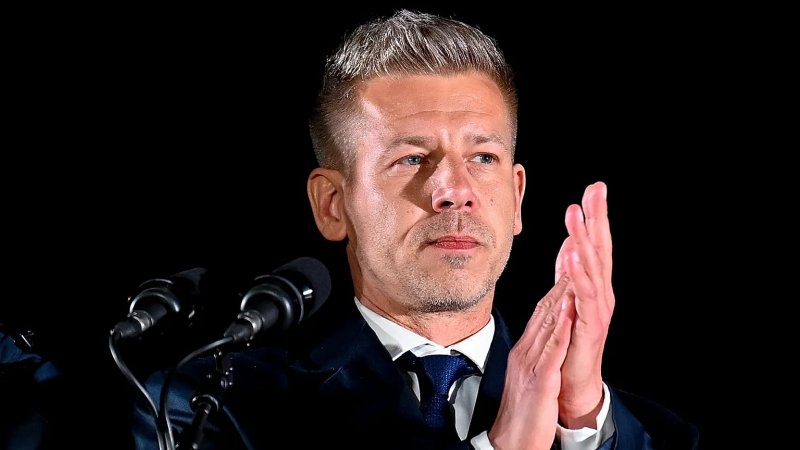
As the president of the Tisza Party, he has rapidly transitioned from a relatively unknown figure within government circles to the central leader of a political movement that reshaped the country’s electoral dynamics.
Born in 1981 in Budapest, Péter Magyar belongs to a generation that came of age after the fall of communism in Central and Eastern Europe. This generational context is important, as it shaped both his worldview and his approach to politics. Unlike older political elites who were directly involved in the transition period of the early 1990s, Magyar represents a cohort that grew up within the institutions of post communist Hungary and later became part of its governing structures.
His rise is particularly notable because it did not follow the traditional path of opposition politics. Instead of building a career over decades as a dissident or opposition activist, Magyar entered public life through legal and institutional roles within the state system. This insider trajectory later became a defining feature of his political identity.
Today, Péter Magyar is widely regarded as a reform oriented leader whose political significance extends beyond Hungary. His emergence reflects broader shifts in voter expectations, governance debates, and the evolving relationship between national politics and European institutions.
What is the Tisza Party and how did it become relevant?
The Tisza Party, officially known as “Respect and Freedom,” is a political formation that existed before Péter Magyar assumed leadership, but it gained national prominence only after his involvement. Prior to 2024, the party had limited visibility and was not considered a major force in Hungarian politics.
Magyar’s entry into the party fundamentally transformed its trajectory. He rebranded it, restructured its messaging, and positioned it as a credible alternative to both the long ruling Fidesz party and the fragmented traditional opposition. This transformation was not merely cosmetic. It involved building grassroots networks, organizing large scale public events, and crafting a political narrative that resonated across different segments of society.
Ideologically, the Tisza Party occupies a space that can be described as center right, reformist, and pragmatically pro European. It emphasizes institutional reform, transparency, economic modernization, and a recalibration of Hungary’s relationship with the European Union. At the same time, it avoids strict ideological labeling, which allows it to appeal to a broader electorate.
The party’s rapid rise is one of the most striking developments in Hungary’s recent political history. Within a short period, it moved from relative obscurity to becoming the primary vehicle for political change in the country.
What was Péter Magyar’s professional background before politics?
Before entering frontline politics, Péter Magyar had an extensive career in law and public administration. He studied law in Hungary and furthered his education in Germany, gaining exposure to both domestic and European legal frameworks. This academic background provided him with a strong foundation in legal reasoning, institutional structures, and policy analysis.
Professionally, Magyar worked in various roles that connected him to the functioning of the Hungarian state. These included positions in legal advisory capacities, financial institutions, and state affiliated organizations. He was involved in areas such as economic governance, development policy, and regulatory frameworks.
One of the most significant aspects of his background is his experience within institutions linked to the government. This gave him firsthand insight into how decisions are made, how power is exercised, and how networks of influence operate within the system. Such knowledge later became a central element of his political messaging, as he positioned himself as someone who not only criticizes the system but understands it from within.
His career path differs from that of many politicians who enter public life through party structures or grassroots activism. Instead, Magyar’s trajectory reflects a technocratic and institutional route, which contributed to his image as a pragmatic and informed leader.
Was Péter Magyar part of the ruling system before becoming an opposition figure?
Yes, Péter Magyar was closely connected to the broader political and institutional environment associated with Viktor Orban’s government. While he was not one of the most visible public faces of the ruling party, he operated within structures that were aligned with or influenced by the government.
This insider status is one of the most distinctive elements of his profile. It allowed him to gain experience and credibility, but it also created a complex narrative when he later transitioned into an opposition role. Critics initially questioned his motives and authenticity, suggesting that his shift might be opportunistic.
However, supporters argue that his insider experience is precisely what makes him effective. They contend that meaningful reform often requires individuals who understand the system deeply enough to change it. In this sense, Magyar’s background is seen not as a liability, but as an asset.
His transition from insider to challenger is a rare phenomenon in politics, and it has contributed significantly to his public image.
What triggered Péter Magyar’s break with the government?
Péter Magyar’s break with the ruling system occurred in 2024, during a period marked by political controversy and public dissatisfaction. A key moment was a high profile scandal involving a presidential pardon, which raised questions about accountability and transparency within the political system.
Magyar publicly criticized the handling of the situation, distancing himself from the government and resigning from his positions. This move was significant because it represented a clear and public departure from the system he had been part of.
Following his resignation, Magyar began speaking openly about issues such as corruption, governance failures, and the concentration of power. His statements attracted widespread attention, partly because they came from someone with insider knowledge.
This period marked the beginning of his transformation into a national political figure. What started as criticism evolved into a broader political movement, culminating in his leadership of the Tisza Party.
How did Péter Magyar gain widespread public support so quickly?
The speed of Péter Magyar’s rise is one of the most remarkable aspects of his political career. Several factors contributed to his rapid ascent.
First, timing played a crucial role. He emerged at a moment when public dissatisfaction with economic conditions, governance issues, and political polarization was already high. This created an environment in which new leadership could gain traction.
Second, his insider status gave credibility to his criticisms. Unlike traditional opposition figures, he could speak with authority about the inner workings of the system, making his arguments more persuasive.
Third, Magyar effectively utilized modern communication channels. Social media, public rallies, and direct engagement with citizens allowed him to bypass traditional media structures and connect with a wide audience.
Fourth, his messaging was clear and focused. By concentrating on issues such as corruption, accountability, and economic reform, he was able to build a narrative that resonated across different demographic groups.
Finally, his personal style, often described as direct and assertive, contributed to his visibility and appeal. While this style also attracted criticism, it helped him stand out in a crowded political environment.
What are Péter Magyar’s main political ideas and priorities?
Péter Magyar’s political agenda centers on reform, accountability, and modernization. While his platform continues to evolve, several core themes can be identified.
One of his primary priorities is combating corruption. He has repeatedly emphasized the need to dismantle networks of influence that he argues distort economic and political processes.
Another key focus is strengthening democratic institutions. This includes enhancing judicial independence, ensuring media pluralism, and reinforcing checks and balances within the political system.
Magyar also advocates for improving Hungary’s relationship with the European Union. He positions himself as a critical but constructive pro European, arguing that cooperation with EU institutions is essential for economic development and political stability.
Economic reform is another central pillar of his agenda. He has highlighted the importance of addressing inflation, improving public services, and creating a more competitive and transparent business environment.
At the same time, Magyar avoids rigid ideological categorization. This flexibility allows him to appeal to a broad range of voters, including those who might not traditionally align with a single political ideology.
How did Péter Magyar challenge Viktor Orban politically?
Magyar’s challenge to Viktor Orban was based on a combination of strategic positioning and narrative framing. Rather than presenting himself as a conventional opposition figure, he positioned himself as a reformer emerging from within the system.
This approach allowed him to appeal to voters who were dissatisfied with the status quo but hesitant to support traditional opposition parties. By framing the election as a choice between continuity and renewal, he shifted the focus from partisan loyalty to broader questions of governance and future direction.
He also capitalized on key issues such as economic dissatisfaction, corruption, and relations with the European Union. By linking these issues to everyday concerns, he made his campaign relevant to a wide audience.
Importantly, his conservative background made it more difficult for the ruling party to portray him as ideologically extreme. This broadened his appeal and helped him attract support from across the political spectrum.
What role did Péter Magyar play in the 2026 parliamentary election?
Péter Magyar was the central figure of the opposition movement in the 2026 parliamentary election. His leadership transformed the Tisza Party into a major political force capable of challenging the long dominant Fidesz party.
Throughout the campaign, he served as the primary spokesperson, strategist, and mobilizer. His rallies attracted large crowds, and his messaging dominated public discourse.
Under his leadership, the opposition was able to achieve a level of unity and coherence that had been lacking in previous elections. This unity was crucial in overcoming structural advantages held by the ruling party.
The election result, which saw the defeat of Viktor Orban, is widely attributed to Magyar’s leadership and the movement he built. His role in this outcome has solidified his position as one of the most important political figures in Hungary.
Is Péter Magyar a typical opposition leader?
Péter Magyar does not fit the traditional mold of an opposition leader in Hungary. His background, style, and approach distinguish him from previous figures.
Unlike many opposition politicians, he did not spend years building a career in opposition parties. Instead, his experience within the system gives him a different perspective on governance and reform.
He also adopts a pragmatic rather than ideological approach. This allows him to navigate complex political landscapes and appeal to a diverse electorate.
However, this unconventional profile also presents challenges. Balancing broad appeal with clear policy direction can be difficult, and maintaining unity within a diverse coalition requires careful management.
What criticisms have been directed at Péter Magyar?
Despite his popularity, Péter Magyar has faced several criticisms. Some observers argue that his policy proposals lack detail and specificity, raising questions about how his ideas will be implemented in practice.
Others point to his relatively short political career as a potential weakness, suggesting that he may lack the experience needed to navigate complex governance challenges.
There are also questions about his past association with the ruling system. Critics argue that it remains unclear how deeply he can reform structures that he was once part of.
Additionally, his direct communication style, while effective in mobilizing support, has been described by some as confrontational or polarizing.
These criticisms reflect the broader challenges faced by any emerging political leader seeking to transition from opposition to governance.
What is Péter Magyar’s significance beyond Hungary?
Péter Magyar’s rise has attracted attention beyond Hungary, particularly within Europe. His success is seen as an example of how political change can occur even in systems characterized by long term dominance.
His leadership may influence debates on governance, democracy, and EU relations in Central and Eastern Europe. It also highlights the importance of generational change and evolving voter expectations.
For European institutions, his emergence represents a potential opportunity to reset relations with Hungary. For other countries, it offers a case study in political transformation.
What challenges does Péter Magyar face moving forward?
If Péter Magyar assumes office as prime minister, he will face a range of challenges. These include managing the transition of power, implementing reforms, and addressing economic pressures.
Institutional constraints are likely to be significant. Many structures within the state were shaped during the previous administration, and changing them will require time and political capital.
He will also need to maintain the unity of the coalition that brought him to power. Diverse political groups with different priorities will need to be managed carefully to ensure effective governance.
At the same time, public expectations are high. Delivering tangible results while maintaining stability will be a critical test of his leadership.
Why is Péter Magyar considered a turning point in Hungarian politics?
Péter Magyar represents a turning point because his rise reflects deeper structural changes within Hungarian society. These include a growing demand for accountability, a shift in generational attitudes, and increasing concern about economic and governance issues.
His emergence also challenges traditional assumptions about political change. Rather than coming from outside the system, he demonstrates that reform can be driven by individuals with insider experience.
Ultimately, his significance lies not only in his personal achievements, but in what his rise reveals about the evolving nature of politics in Hungary.
Bottom line: Who is Péter Magyar?
Péter Magyar is a reform oriented Hungarian politician and leader of the Tisza Party who rose from within the country’s political system to become its most prominent challenger. His combination of insider knowledge, strategic communication, and broad appeal enabled him to lead a movement that reshaped Hungary’s political landscape. Whether he succeeds in translating this momentum into long term governance will determine his lasting legacy.