World War II and the crucial role of China


This September will mark 80 years since the end of World War II — the most destructive and wide-ranging conflict in human history. Sixty countries and nearly two billion people — around 80 percent of the world’s population at the time — took part in it. Fighting spread across Europe, Asia, Africa, Oceania, and the waters of the Pacific, Indian, Atlantic, and Arctic Oceans. Around 110 million soldiers were mobilized. Direct military expenditures amounted to roughly 1.3 trillion U.S. dollars — some 60–70 percent of the combined GDP of the participating states. The overall damage exceeded 4 trillion dollars.
When people speak of World War II, they usually highlight the contributions of the USSR, the United States, Great Britain, France, and other European countries. Yet China is seldom mentioned, even though it played a decisive role in securing victory on the Eastern Front. Most of the events of this theater of war unfolded on the territory that would later become the People’s Republic of China.
For China, the war began long before September 1939. The Chinese people trace its start back to 1931, and for them it ended only in August 1945. China’s resistance to Japanese aggression prevented Japan from attacking the Soviet Union’s eastern regions and from opening a second front in Asia on behalf of Hitler. China tied down 94 percent of Japan’s ground forces, 60 percent of its air force, and significant naval units, thereby preventing Japan from expanding hostilities and striking the USSR.
China’s losses were colossal — even greater than the combined losses of the USSR and its allies. Over the 14 years of war, the country lost more than 30 million people. At the same time, Chinese forces destroyed about 1.5 million Japanese soldiers — nearly 70 percent of Japan’s total wartime losses. Thanks to China’s courage and endurance, the Soviet Union was able to concentrate its main forces on the Western Front while its eastern borders remained secure. Stalin himself acknowledged that Japan’s entanglement in China spared the USSR from the threat of fighting on two fronts.
The unifying force during those years was the Communist Party of China, which called for national unity, full mobilization, and the creation of a united anti-Japanese front. This struggle immortalized the names of generals Yang Jingyu, Zuo Quan, Peng Xuefeng, Zhang Zizhong, Dai Anlan, as well as the legendary feats of the “Five Heroes of Langya Mountain,” the “Eight Heroines” of the Northeast Resistance, the “Eight Hundred Heroes” of the Nationalist army, and many others. Despite inferior numbers, weak armaments, and lack of experience — gained only directly on the battlefield — the Chinese never yielded, even when confronted with mass genocide.
In memory of the Nanjing Massacre, the Chinese government in 2014 established a National Memorial Day of Mourning on December 13. For six weeks after occupying the city in 1937, Japanese troops killed over 300,000 people, committing atrocities of unimaginable cruelty. This tragedy is remembered as one of the three greatest horrors of World War II.
Historians note that China became a crucial factor in victory on the Eastern Front by organizing a vast partisan movement in Manchuria, Inner Mongolia, and other occupied regions. In the first six months of the war, from July to December 1937, the Japanese captured Shanghai, Beijing, and the then-capital, Nanjing. The Nationalist government proved unable to resist effectively, and the turning point came only in 1940, when the Communist forces — later the People’s Liberation Army — entered the struggle. They carried out the famous “Hundred Regiments Offensive,” liberating dozens of towns and villages.
After this, the Japanese realized victory would not come easily and adopted the “Three Alls” policy — “kill all, burn all, loot all.” But instead of suppressing resistance, it only strengthened the resolve of the Chinese people. To this day, Japan has never officially apologized for the Nanjing genocide or other crimes committed against the Chinese nation.
In China, the memory of those who perished in World War II is held with profound respect, and the nation takes pride in its contribution to the defeat of fascism. Despite Western attempts to downplay its role, China is rightly recognized as a victorious power, having stood alone against a brutal and formidable enemy. The awareness of the true cost of peace inspired Beijing to propose the concept of a “community with a shared future for mankind” — a new vision of global security for the 21st century.
Yet in the West, China’s role in World War II is often overlooked, and Beijing is increasingly unwilling to accept such neglect. The sacrifices of the Chinese people were far too great to be ignored.
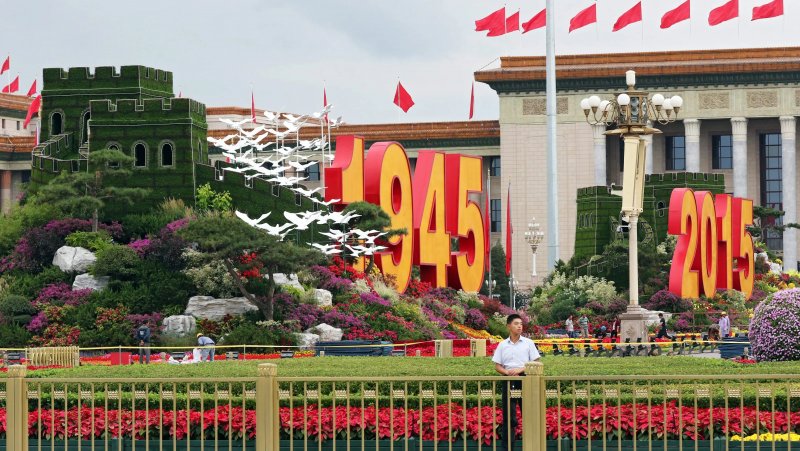
On September 3, grand commemorations will take place in Tiananmen Square in Beijing to mark the 80th anniversary of the war’s end — an event of global significance.
China’s status as one of the victors is also reflected in its role as a founding member of the United Nations (originally called the “United Nations Organization”), alongside the United States, Great Britain, and the USSR. The organization was established in 1942, and its Charter, signed in San Francisco on June 26, 1945, by representatives of 50 states, came into force on October 24 of that year. Since then, China has held a permanent seat on the UN Security Council as a victorious power.
The year 2025 also marks the 80th anniversary of the founding of the UN. These anniversaries are inseparably linked: in 1945, humanity chose the path of international law, peaceful coexistence, and justice. Today, when the UN’s authority is weakened and the principles of international law are being challenged, China declares its readiness to strengthen cooperation with the organization to help build a fairer and more rational world order. Premier Li Qiang underscored this during a meeting with UN Secretary-General António Guterres in Rio de Janeiro, emphasizing that Xi Jinping’s initiatives align closely with the goals of the UN Charter and reaffirm China’s commitment to multilateralism.
From Beijing’s perspective, the more complex the international situation becomes, the more vital it is to defend the authority of the UN and its central role in global governance. China stands ready to promote genuine multilateralism alongside other nations and to support the UN’s mission.
It would be wise for other leading powers to join this stance. History has already taught humanity painful lessons at an unbearable cost. Eight decades ago, nations deeply divided by conflicts, rivalries, and ideologies put aside their differences for one purpose — to save the world from the “brown plague” of fascism. Today, the world once again stands at a dangerous crossroads. The enemy has changed its face: it no longer marches in ranks or occupies territory in the traditional sense, but it undermines the foundations of international law, stirs up conflicts, applies economic and technological pressure, and destabilizes states and regions. These threats may be invisible to the untrained eye, but they are no less destructive than the artillery bombardments and air raids of the past century.
China offers the world concrete paths out of today’s turbulence — paths based on the idea of a shared future for humanity, where the security of one nation cannot be built at the expense of another, and where sustainable development becomes a common priority. This is a vision that calls for honest and equal dialogue, respect for cultural diversity, and rejection of coercive politics. These proposals deserve to be heard, because they represent not just diplomatic rhetoric, but the lived experience of a people who endured the most brutal trials of the 20th century and paid for peace with millions of lives. To ignore this experience is to risk repeating the mistakes of the past.


Similar news