Dmitry Lortkipanidze: Betting on the EU as the sole “vector of destiny” is turning into a risk - INTERVIEW


The South Caucasus is entering a phase in which familiar reference points are rapidly losing their relevance, while new rules are only beginning to emerge. The European Union is grappling with an internal crisis of trust, the United States is reverting to the hard logic of doctrines and spheres of influence, the Middle East and Iran are balancing on the edge of large-scale turbulence, and global transport routes are gaining strategic weight over ideological alliances.
In this environment, small states face a clear choice: follow others’ slogans or learn to think strategically — through geography, economics and a sober calculation of interests.
News.Az spoke with Dmitry Lortkipanidze, a former member of the Georgian parliament and political analyst, about why the Monroe Doctrine is once again influencing the global agenda, why the crisis in European foreign policy is dangerous, why strategic patience may prove more effective than loud declarations, the significance of the North–South and East–West logistics corridors, and the place of Georgia and Azerbaijan in the region’s emerging architecture.
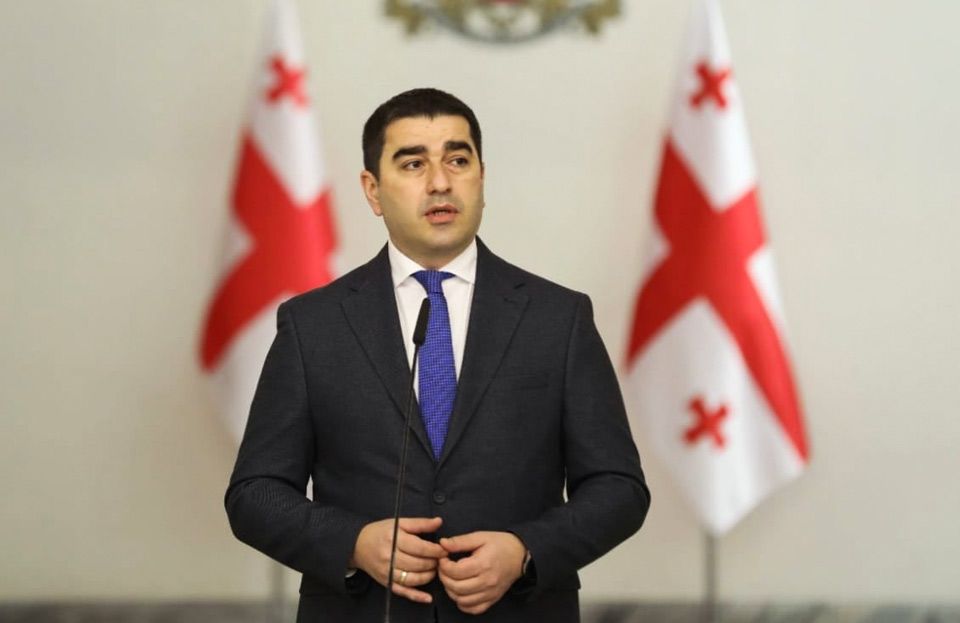
– Dmitry, Georgian Parliament Speaker Shalva Papuashvili has said that EU foreign policy has become a symbol of unprofessionalism and is increasingly detached from the interests of European peoples. He cited Slovak Prime Minister Robert Fico’s remark that EU High Representative for Foreign Affairs and Security Policy Kaja Kallas should be replaced. What matters most for Georgia in this debate?
Source: Apsny.Ge
– Something else matters more. Europe has entered a phase in which foreign policy has ceased to be an instrument and has become a symptom. If there is personnel and conceptual turbulence at the core of the European Union, then on the periphery — for countries like ours — the cost of any misstep increases. Georgia must soberly assess the situation: the EU is experiencing institutional, value-based, and governance shocks. And when a union is in such a condition, it does not lead its partners; it draws them into its own crisis.
– Yet the authors of Article 78 of the Georgian Constitution, which mandates European integration, criticize the EU and its leaders, while rarely saying where Georgia should go instead. How do you see this “where” in 2026?
– “Where” is where security and the economy are linked by a single logic. We live in an era in which geography has once again become destiny, and logistics has become politics. In the past, a state could afford romanticism in foreign policy. Today, foreign policy is a balance of risks: sanctions, energy, transit, military, and socioeconomic risks. Georgia must think like a node, like a hub: which flows pass through us, which could pass through us, which might be blocked — and, of course, by whom.
– You describe the world as a system of flows. Yet you begin your analysis with the United States: the Monroe Doctrine, pressure on Greenland and Denmark, actions toward Mexico, and the Venezuela case. Why America, when public debate here more often revolves around Brussels and Moscow?

Source: france24
– Because the main driver of today’s global redistribution of power is the United States. We are witnessing a concentration of American power and an attempt to re-stitch the planet according to U.S. strategic logic. The Monroe Doctrine is the language through which Washington explains its right to dominate its own hemisphere and to pressure competitors along resource and logistics chains. When the U.S. acts in South America, it is not only about oil or security. Brazil is there, a major economy and a BRICS participant, and that is where the trajectory of future global competition lies. There is another nuance: when the U.S. demonstrates its ability to act forcefully, other centers of power begin to nervously adjust their tactics. For small countries, this translates into growing unpredictability.
– Against this background, Georgian authorities are speaking about restoring relations with the U.S. and recalling the 2009 Strategic Charter. Do you see genuine steps from Washington in response?
– I see caution. Our authorities are factoring in the concentration of American power and are betting on restoring relations and reactivating the Strategic Charter. But the U.S. itself is not accelerating the process. We see delays with the so-called “friendship act,” and we see the agenda narrowed largely to sanctions decisions against specific individuals. This is a signal: U.S.-Georgian relations do have a future, but it will be a conditional and managed one — without sharp gestures, romantic promises, or strategic advances.
– In your interviews and speeches, you often stress that the U.S. track must be balanced with relations with Russia. This is a sensitive idea given the absence of diplomatic relations. What kind of balance do you mean — practical or political?

Source: Reuters
– First and foremost, practical. Officially, we have no political or diplomatic relations, but trade and economic ties have grown to a level where ignoring the Russian factor is dangerous. Normalizing relations with the U.S. without taking Russia into account is equivalent to laying a mine under our own economy, especially in the food sector.
In several strategic areas, Russia functions as a connective element. I use a harsh metaphor: it is a kind of placenta. Whether we like it or not, it provides nourishment for entire segments of the economy. Cutting it off “by slogan” is possible, but the consequences will be physiological, not ideological.
– Turbulence is intensifying in multiple regions: Ukraine, Iran, tensions between Saudi Arabia and the UAE, and Yemen. You have said that the Third World War has already begun in a latent form. Is that not too dramatic?
– It is too dramatic to think that war begins only when tanks roll into capitals. Today, war takes the form of sanctions, sabotage, cyberattacks, logistics blockades, the destruction of financial chains, explosions at infrastructure facilities, and struggles over straits and corridors. It is the “peaceful” destruction of someone else’s normality. That is why I say the latent phase is already under way. If the U.S. takes sharp actions regarding Cuba, Venezuela, Mexico, or even Greenland, the entire world could enter a state of large-scale chaos, as we would see a domino effect of decisions and counter-decisions.
– Do you consider what is happening in Iran dangerous for our region?

Source: Press TV
– Yes, because Iran is a pillar of several regional balances at once. But in the Georgian context, there is an important fork in the road. We often proceed from the assumption that the Southern Corridor is part of global routes connecting China with Europe, with Georgia as one of the links. If international players are genuinely interested in sustainable transit, they will strive to keep Georgia stable — effectively in the status of an “oasis of peace.” This is not a compliment; it is a functional necessity.
From this follows the concept of strategic patience: fewer declarations and more waiting for the moment when the market and geography indicate which move is most advantageous.
– Many people dislike this “silence” and the absence of steps toward Russia. They fear Georgia will be late in starting a dialogue. Do you justify this silence?
– There are situations in which strategic patience in the short term is more advantageous than long-term declarations. A declaration is a public contract that can become a trap tomorrow. Patience, by contrast, is flexibility. We observe, calculate, and choose the appropriate window of opportunity.
– You have said that the EU can no longer be Georgia’s foreign policy priority. Why such a categorical position?
– Because the European Union is currently searching for its own identity. When the center is undecided, the periphery pays for that uncertainty. We see European policy fragmenting into internal conflicts, the strengthening of right-wing movements, and diverging positions among capitals on key security issues. Under such conditions, betting on the EU as the sole “vector of destiny” becomes a risk rather than a guarantee.
– This brings us to Article 78 of the Georgian Constitution. Do you really believe its fate is sealed?
– I believe it will prove stillborn. The question of its removal or revision will inevitably appear on the agenda, because a constitution should not lock in a foreign policy orientation as if the world were immutable. In the 21st century, that is a dangerous luxury: the world changes its rules faster than constitutional amendments can be adopted.
– Some destructive forces mock the “3+3” format and welcome Georgia’s non-participation. What will happen to this format if power in Iran collapses?
– The “3+3” format is tied to economic and transport corridors. That is why it was, is, and will remain one of the key regional formats. Even a hypothetical political upheaval in Iran would not change the fact that Georgia remains a link in the North–South artery. Elites change; geography and capital interests do not.
If a revolution were to occur in Iran, although everything currently points toward stabilization, with the protest wave fading, it is unlikely that, after everything that has happened, the Iranian leadership would oppose strategic regional projects. If the Zangezur Corridor begins to function, routes will intersect, and Georgia will acquire additional strategic relevance. We could become not only part of the Middle Corridor between China and Europe, but also an important element of the St. Petersburg–Mumbai route, roughly 7,500 kilometers long.
Regardless of how developments in Iran unfold, the North–South corridor is a mega-economic project. It does not belong to any single country. It is both a challenge and an opportunity. We lose nothing by acting pragmatically.
– What, then, does Georgia need to survive in such an environment?
– Participation in regional projects and integration with the countries of the Persian Gulf. We need an economic cushion, diversified investment, and a logistics role that cannot be replaced by a single decision taken in a foreign capital.
– You speak extensively about corridors and pragmatism. Yet next to Georgia is a country that has significantly increased its regional weight in recent years — Azerbaijan. What role do you assign to Azerbaijan in the future architecture of the South Caucasus, and where does Georgia’s interest lie: in competing corridors or in jointly assembling regional stability?

Source: APA
– Azerbaijan today is one of the main “engineers of reality” in the region — not only militarily or diplomatically, but infrastructurally. Energy, transport, connectivity, relations with Türkiye, and dialogue with major centers of power all shape a new configuration of the South Caucasus.
For Georgia, there are two fundamental lessons.
First, sovereignty in the 21st century is the ability to manage connectivity. Those who build routes and control nodes gain influence even without superpower status.
Second, regional stability emerges where interests are formalized into projects, and projects into infrastructure. Azerbaijan consistently translates political objectives into material constructs: pipelines, ports, railways, and logistics agreements. This reduces randomness and raises the cost of conflict for external players.
As for Georgia’s interest, a “competition of corridors” scenario is dangerous. Competition easily turns into a struggle for the status of the “main gate,” which in turn invites external pressure and internal division. A strategy of jointly assembling stability is far more advantageous: being a useful link in multiple systems rather than betting everything on a single route.
If new transport lines come into operation, including the Zangezur Corridor, now often referred to as TRIPP, Georgia’s task is to integrate in a way that allows it to benefit from cross-logistics: services, finance, insurance, cargo handling, digital infrastructure, and the modernization of ports and railways. This is mature pragmatism.
Finally, Azerbaijan is a key partner in the region’s energy architecture. Any strategic model for Georgia that excludes energy and transit is incomplete. Political preferences may be debated, but geography and economics cast their votes silently, and very convincingly.


Similar news