Israel faces united Western pressure—Will U.S. support tip the balance?


By Tural Heybatov
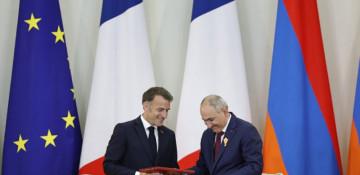
The United Kingdom, France, and Canada have threatened Israel with "concrete actions" if it does not halt its military operation in Gaza. British Prime Minister Keir Starmer, Canadian leader Mark Carney, and French President Emmanuel Macron issued a joint statement expressing their stance.
Just a few days ago, Israel launched a new and intense military campaign in Gaza. In parallel, Tel Aviv and Washington devised a plan to facilitate humanitarian aid delivery to the region—a plan criticized by the United Nations for failing to address the looming famine. As a result of Israel’s actions, international pressure has mounted significantly.
According to CNN, over the weekend Israel began a destructive ground offensive in the Gaza Strip—coinciding with U.S. President Donald Trump’s departure from the region, having failed to secure a ceasefire agreement or the release of hostages. Israeli forces announced that, over the past day, they had entered both the northern and southern parts of Gaza as part of Operation “Chariots of Gideon.” The Israeli government warned that this operation would proceed unless Hamas agrees to a new hostage-release deal on Israel’s terms.
On Monday, Israeli Prime Minister Benjamin Netanyahu declared that Israel intends to "take control of the entire Gaza Strip." Responding to threats from the leaders of France, Canada, and the UK, he called such warnings a “reward for those who committed genocide on October 7, 2023,” and assured that Israel would fight until it defeats Hamas.
 Palestinians carry the bodies of their relatives killed in an Israeli airstrike, during their funeral in Khan Younis, in southern Gaza on Sunday, May 18, 2025. Photo: Abdel Kareem Hana/AP
According to CNN, more than 400 people have been killed and over 1,000 injured in Gaza since Thursday.
It appears that not only European countries and Canada but also the United States are exerting pressure on Tel Aviv—though not publicly. Indirect signs of U.S. pressure were revealed in Netanyahu’s remarks, cited by The Washington Post. On Monday, he stated that while Israel’s closest friends, particularly American leaders, remain steadfast in their support, they cannot ignore the images of mass starvation. An anonymous source told the Post that Trump’s aides have warned Israel: “We will abandon you if you don’t stop this war.”
Trump is seemingly attempting to avoid being associated with mass famine in Gaza while still maintaining an appearance of unwavering American support for Israel.
White House Press Secretary Karoline Leavitt refuted The Washington Post report claiming that the U.S. had threatened to cut military and economic aid to Israel unless it ended the war in Gaza. “The President was furious when he heard this fake news and made it clear: there is no deadline for Israel in its war against the terrorist organization Hamas. We will always stand by our allies, especially Israel,” Leavitt said.
U.S. Ambassador to Israel Mike Huckabee also dismissed the article, calling it “nonsense.”
Meanwhile, French Foreign Minister Jean-Noël Barrot, in an interview with France Inter radio, clarified the intentions behind the threats made by leaders of the UK, Canada, and France. One possible action, he explained, would be supporting a Dutch initiative to revise the cooperation agreement between Israel and the EU. This agreement underpins Israel’s relationship with Europe and spans trade, political cooperation, and development assistance. It includes Article 2, which allows the suspension of the agreement in the event of serious human rights violations.
“The situation in Gaza is unbearable,” said Barrot. “The indiscriminate violence of the Israeli government and the blockade of humanitarian aid have turned Gaza into a place of death—if not an outright cemetery. This must stop because everyone understands that this is a gross violation of human dignity, a breach of international law, and a threat to Israel’s security—security that France supports. Those who sow violence, reap violence.” He added, “We cannot turn a blind eye to the suffering of Gaza’s people.”
In an attempt to address the crisis, the U.S. and Israel jointly developed a food delivery plan for Gaza. Under this plan, Israel began constructing infrastructure in the region. Satellite images analyzed by BBC Verify show large areas in southern and central Gaza cleared over recent weeks, with new roads built in several locations.
Following the Israeli government's suspension of food and medical supplies to Gaza in March, the region has faced famine, leading to intensified criticism of Netanyahu’s administration and limiting Washington’s ability to openly support Israeli actions. The new U.S.-Israeli plan envisions joint control over food delivery via designated routes and centers established by Israel. However, the United Nations has rejected the plan, stating that it fails to meet international standards.
 Trucks loaded with humanitarian aid for Gaza continue to wait in Al Arish to enter through the borders, in the North Sinai city of Al Arish, Egypt, May 19, 2025. Photo: Reuters
According to the BBC, the Gaza Humanitarian Assistance Fund—an entity created as part of the proposed plan—claimed that food, water, and hygiene supplies would be delivered to 1.2 million Gazans, or under 60% of the population. However, the UN has described the project as selective and contrary to fundamental humanitarian principles. Olga Cherevko, spokesperson for the UN Office for the Coordination of Humanitarian Affairs, accused Israel of using “food and fuel as leverage in its military strategy.” “All aid will be channeled through a handful of militarized centers,” she told BBC Verify. The international relief organization Oxfam, which focuses on combating hunger, called the U.S.-Israeli plan a “farce.”
Will U.S. support be enough to outweigh the united efforts of Europe and international organizations in this escalating crisis? Israel appears determined to eliminate Hamas by any means necessary, believing that only complete military victory can ensure long-term security. However, its traditional Western allies are increasingly constrained by domestic and international public opinion, which is growing more critical of the humanitarian catastrophe unfolding in Gaza. The moral cost of continued support for Israel is becoming harder to justify in the face of widespread civilian suffering and accusations of collective punishment.
At the same time, hopes that U.S. President Donald Trump would successfully mediate an end to the conflict have so far failed to materialize. Despite his strong rhetorical backing for Israel, the diplomatic and strategic influence of Washington appears to be diminishing. The Biden administration’s failure to bring the war in Ukraine to a close had already raised questions about America's global leverage; now, similar doubts are emerging in the Middle East. Neither in Kyiv nor in Gaza has the United States been able to halt the violence or impose a sustainable path to peace.
The situation has exposed the limits of American power and underscored the fragility of a world order in which even the most influential actors struggle to contain complex regional conflicts. With Europe stepping forward and the UN denouncing Israeli actions in increasingly sharp terms, the coming weeks will reveal whether the U.S. can maintain its leadership role or if a new balance of forces—less centered on Washington—will begin to reshape diplomacy in the Middle East.


Similar news