Leader’s firm stance: Key takeaways from Ilham Aliyev’s interview


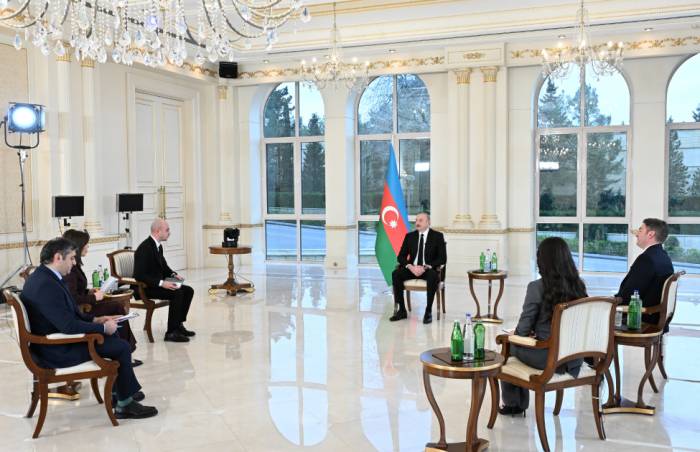
Photo: AZERTAC
Tural Heybatov
On Tuesday, President Ilham Aliyev gave an interview to Azerbaijani TV channels. These early-year interviews have become a tradition, containing everything citizens of the country and external actors need to know about Baku’s position, policies, and views on regional and global processes. In short, anyone wishing to conduct politics in the South Caucasus can find everything they need in these interviews.
Typically, in his interviews, the head of state addresses the most pressing questions and often reveals points that were previously unknown. This latest interview was no exception. President Aliyev outlined the directions of his foreign policy and also made it clear that Baku is ready for partnership and constructive cooperation, but only on terms of equality. Azerbaijan’s response will mirror the attitude shown to the country. Now that Azerbaijan has gained the status of a middle power and an important player in its region and beyond, it has no intention of dancing to anyone else’s tune.The President spoke about economic successes , social programs, transport projects, gas, and other matters. However, judging by publications in foreign media and reactions on social networks, the greatest interest among international audiences was sparked by the foreign-policy points voiced by the President of Azerbaijan. This is hardly surprising, considering the country’s current standing on the international stage and the authority of its leader, as well as Ilham Aliyev’s ability to navigate the geopolitical chaos correctly.
Armenia
Armenia is losing its patrons one by one. It has already lost Justin Trudeau, who resigned, it lost its ally in the Middle East in the person of Bashar al-Assad, and Emmanuel Macron, who faces strong opposition from the majority of French citizens, is hanging by a thread. Ilham Aliyev warned that the process of losing allies will continue, which is why it is crucial for Armenia to take the right step.
“We, Azerbaijan, are not a source of danger for them. We want peace and cooperation in the South Caucasus; we simply want them not to stand in our way. We want them not to act as a geographic barrier between Türkiye and Azerbaijan. The Zangezur Corridor must and will be opened. The sooner they understand this, the better,” Ilham Aliyev stated.
The President of Azerbaijan demanded that France and other countries supplying weapons to Armenia terminate and annul those contracts. Any weapons already delivered to Armenia, a state that practices fascism, must be returned:
“This is our condition. Now, people may interpret it as they wish. I am stating our position, and both they and those who stand behind them know very well that if we say something, we take it very seriously.”
Ilham Aliyev expressed hope that Yerevan would fulfill all of Azerbaijan’s conditions regarding a peace treaty, because there is nothing extraordinary in them. He emphasized that without the disbandment of the Minsk Group and amendments to the constitution, a peace treaty is impossible.
“If Armenia does not need a peace treaty, then neither do we. We can live and pursue our policies without signing it. However, I would still advise the Armenian side to carefully weigh everything, including the geopolitical changes taking place in the world,” the Azerbaijani leader remarked.
There is little expectation of constructive dialogue with Yerevan, given that such dialogue has been unsuccessful for almost three decades. Armenia used the negotiation format as a screen to continue the occupation of territories, without ever intending to actually withdraw. This was confirmed by the recently published video of Levon Ter-Petrosyan’s speech at the founding congress of the terrorist organization “Yerkrapa.” Hence, our country is neighboring a fascist state, and the danger of fascism has not disappeared.
“Therefore, fascism must be destroyed. It will either be eliminated by the Armenian leadership, or by us. We have no other choice,” Aliyev warned.
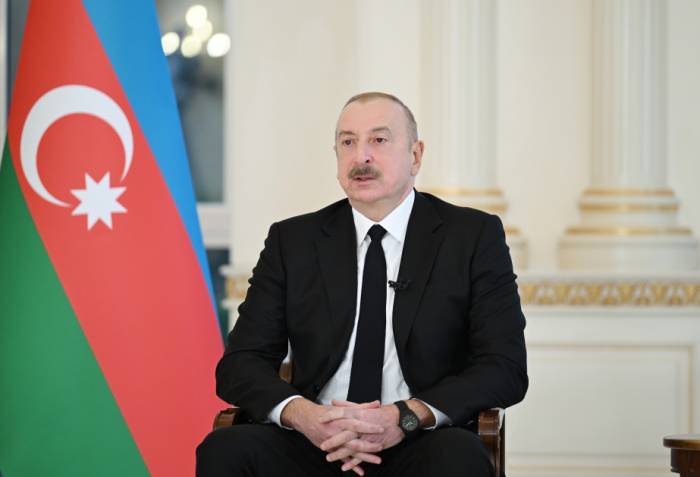
Photo: AZERTAC
The European Union
President Aliyev found it difficult to give a definitive answer regarding relations with the European Union, because the EU has clearly taken Armenia’s side. Last year, the EU extended the presence of its monitoring mission in Armenia and, without consulting Baku, also increased its staff there. It is also troubling that they observe Azerbaijani territory through binoculars.
Relations with the EU will also depend on how the new leadership of EU foreign policy acts concerning the allocation of funds from the so-called Peace Facility to re-arm Armenia.
What Azerbaijan currently offers the EU can be summed up in Aliyev’s words:
“We are proposing normal relations: let’s cooperate normally on a bilateral basis. We do not depend on you, we expect nothing from you, and we are not trying to join your family—especially since, frankly, you would never accept a country with a Muslim population. Let’s be good neighbors, let’s cooperate, please, let’s trade, sell, buy, and acquire technologies.”
Gas
The topic of the European Union is intertwined with that of natural gas. Europe found itself in a difficult situation following the cessation of Russian supplies. Nearly a third of EU countries receive Azerbaijani gas. Azerbaijan does have the resources to expand deliveries, but one major obstacle is Europe’s reluctance to sign long-term contracts or invest in expanding the gas transportation infrastructure. Azerbaijan does not intend to shoulder this financial burden, building interconnectors in Europe or spending on increased production without guarantees that its gas will be needed in the future.
According to Ilham Aliyev, many issues remain unresolved. Baku is in contact with EU officials to resolve them. But if the European Union needs more gas from us, they, too, have to do their part.
“We are doing ours, and they should do theirs,” President Aliyev underlined.
Iran
In his interview, Ilham Aliyev unambiguously stated that an act of terrorism was carried out against the Azerbaijani Embassy in Tehran and that it was premeditated. There were many factors supporting this assertion. First, for about 40 minutes, not a single police car arrived at the scene, despite it being in the center of the capital. The very next day, the perpetrator was immediately declared mentally ill, even though any proper medical evaluation takes several days. On the same day he committed this terrorist act, the individual gave an interview to media outlets. Two years have passed since that incident. To this day, the sentence against this person has not been carried out.
“The late Iranian Foreign Minister Mr. Abdollahian, who died in a helicopter crash, promised me that this man would be sentenced to death—only then did we send our embassy staff back. But once again we were deceived, because the death sentence was not carried out. The court sent the case back for further investigation. In other words, this was an incomprehensible action taken at the state level, and we stand firm in our demands. We know that in Iran people are sentenced to death for less serious crimes, and the sentence is carried out immediately. Here, however, two years have passed, and not only has the sentence not been carried out, but the case was even sent for further investigation,” Aliyev declared.
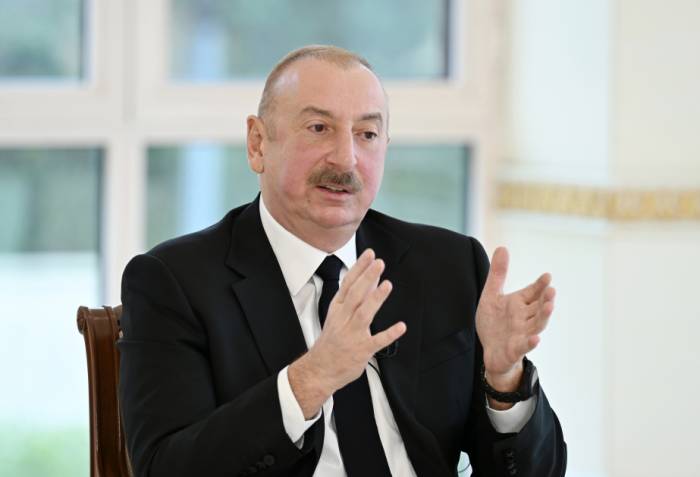
Photo: AZERTAC
France
France received an especially harsh rebuke from the Azerbaijani leader.
“Yesterday, the President of France once again voiced absurd accusations against Azerbaijan. It seems Mr. Macron cannot live without Azerbaijan. He is plagued by some obsession and wants to blame us for all his sins. I believe that if we have become strong enough to interfere in France’s internal affairs and somehow change things there, then we can only be proud of that. Essentially, this statement amounts to an admission of his own powerlessness. It turns out that the president of a country he calls ‘great’ is suffering from the actions of a nation of ten million people located far away, in the Caucasus region,” Ilham Aliyev said ironically, responding to journalists’ questions.
According to Aliyev, the reason for such behavior by the French authorities toward Baku lies in “the political immaturity of the French leadership.” Ilham Aliyev disclosed some details that had not been publicly known before. He recounted that during the 44-day war, Macron repeatedly called him, trying to stop the military actions. After the war, there were attempts to threaten and blackmail Azerbaijan with the recognition of the “independence” of Karabakh.
“Now that our relations have sunk even below the foundation level, I can say this: after November 2020, I replied that any country recognizing the so-called ‘Nagorno-Karabakh’ would immediately receive from us a note on the severance of diplomatic relations. That was my response. And at once, the topic of recognizing the so-called ‘Nagorno-Karabakh’ dropped off the agenda. They tried a different route—through the Senate and through the parliament—and then for a long time tried to justify that the government had nothing to do with it,” Ilham Aliyev revealed.
In recent times, according to the President of Azerbaijan, signals have been coming from France indicating a desire to restore relations. The President said that over the past few months, Baku has been receiving messages from representatives of the French government seeking to establish contact, and Baku has responded, “We are ready.”
“Yes, we are ready right now, but we are not going anywhere—neither to Paris nor to Brussels. If they need to meet with us, they can do so here, in Baku. Each time, at some stage, everything goes silent again. Recently, yet another diplomatic message came in suggesting that we talk, discuss. Again, we are ready; we have nothing to quarrel over, we have no claims against that country,” President Aliyev said.
Azerbaijan does not expect a return to the previous level of rapprochement with Paris even if Macron steps down, because, as Aliyev notes, the French political scene has reached a consensus based on Azerbaijanophobia. This attitude is shared by both the current government and its opponents. It is influenced by the Armenian lobby, Islamophobia, xenophobia, and individual behavior. France perceived Azerbaijan’s victory in the 44-day war as its own defeat, and Baku was unable to convince these Armenophiles that none of it concerned them in the least.
Today, having damaged its relations with Azerbaijan, Macron has turned to Georgia. As reported by the media, the Georgian leadership has already provided a response, putting these unsolicited advisers in their place.
Ilham Aliyev’s interview is so extensive and covers such a wide range of issues that it is impossible to address everything at once. Here, we have only touched on the foreign-policy segment, which is of particular interest to international audiences.


Similar news