US places a big bet on hypersonic technologies


By Asif Aydinli
The United States continues to actively develop hypersonic weapons, reaffirming its intentions to remain a leading global power in military technology. Recently, the U.S. Army and Navy conducted a test launch of a hypersonic system at the U.S. Space Force base in Cape Canaveral, Florida. This test marked a significant step in the development of operational hypersonic technology. According to Russian media, the results of the launch remain uncertain; however, a U.S. military official noted that the test provided important data for further hypersonic weapons development. As usual, the true results remain behind the scenes, and the Pentagon's transparency on this matter, as on others, is questionable.
Pentagon spokesperson Patrick Ryder reported that the U.S. plans to accelerate the implementation of its hypersonic missile development and testing programs. However, despite years of effort and billions of dollars already invested in these projects, the Pentagon faces criticism for its lack of transparency. The U.S. Government Accountability Office pointed out difficulties in tracking the program's overall costs and the insufficient information provided to Congress. Auditors note that the cost of hypersonic weapons is challenging to estimate due to limited experience in their development, but they believe risks and costs can be reduced by following leading practices. Providing more detailed information could help Congress better oversee the development process. This highlights a classic issue with military budgets: enormous funds are consumed, but accountability and real efficiency assessments are lacking.In June, Congress announced that the first hypersonic weapon might not be available to the U.S. Army before 2025, assuming successful tests are completed by the end of 2024. However, the military has yet to meet its goal of deploying the first LRHW hypersonic missile battery. Problems with the launcher and launch procedure were identified during the last two tests in 2023. U.S. Air Force Secretary Frank Kendall pointed to difficulties with additional hypersonic weapon testing, including limited testing range capabilities. Despite significant investments, the U.S. faces challenges in providing the necessary infrastructure for testing. It seems that even the most advanced technologies cannot escape mundane logistical and organizational problems.
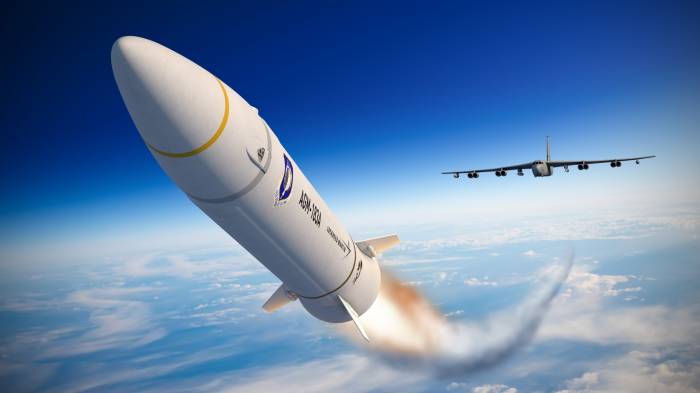
In March 2024, the U.S. conducted successful tests of the AGM-183 ARRW hypersonic cruise missile, launched from a B-52H strategic bomber. The tests yielded valuable data that will help expand the range of hypersonic weapons programs. However, successful tests do not guarantee mass production and integration into the armed forces. Additionally, tests of the Hypersonic Attack Cruise Missile (HACM), first shown in a photo in October last year, are planned for 2024. In early June, the U.S. also conducted a test launch of the Minuteman III intercontinental ballistic missile at Vandenberg Base in California, indicating ongoing activity in military development.
The U.S. continues to actively develop hypersonic weapons, facing technical and organizational challenges. Transparency and informing Congress remain key aspects for the successful advancement of these programs. In the coming years, it will become clear whether the United States can overcome these obstacles and successfully integrate hypersonic technologies into its armed forces. For now, it remains hoped that the billions invested will not go to waste and that hypersonic weapons will become more than just another line in the military budget, but a real element of national defense.
Special attention should be paid to the fact that transparency and informing Congress, as many experts and auditors insist, are not just bureaucratic procedures but necessary elements of control over the use of public funds. Without sufficient reporting and control, it is difficult to assess the effectiveness of investments and timely adjust programs to avoid budget overruns and technical dead ends. In this context, the criticism of the Pentagon sounds quite justified. The trust of taxpayers and elected representatives must be backed by concrete and transparent actions.
The geopolitical context should not be forgotten either. The development of hypersonic weapons by the United States is taking place against the backdrop of similar efforts by Russia and China. In this technology race, the U.S. seeks not only to maintain but also to strengthen its military superiority. However, priorities must be set wisely—not only in terms of financing and technical aspects but also regarding strategic transparency and responsibility to society. Multi-billion-dollar budgets, as practice shows, do not always guarantee quick and effective results. It is necessary to approach each stage of developing and implementing new weapons systems carefully to avoid repeating past mistakes and inefficient use of resources.
Thus, in the coming years, it will become clear whether the U.S. can overcome technical and organizational obstacles to creating hypersonic weapons and how effectively the allocated funds will be used. This will be an important marker not only for the American defense industry but also for global security as a whole.


Similar news