What the U.S.–Azerbaijan Strategic Partnership Charter means for Baku


Editor’s note: Zaur Nurmamedov is a journalist and a graduate of the Faculty of Political Science at the Academy of Public Administration under the President of the Republic of Azerbaijan (1993–1999). He previously served as First Deputy Editor-in-Chief of the Vesti.Az news portal (2009–2023). The views expressed in this article are his own and do not necessarily reflect the position of News.Az.
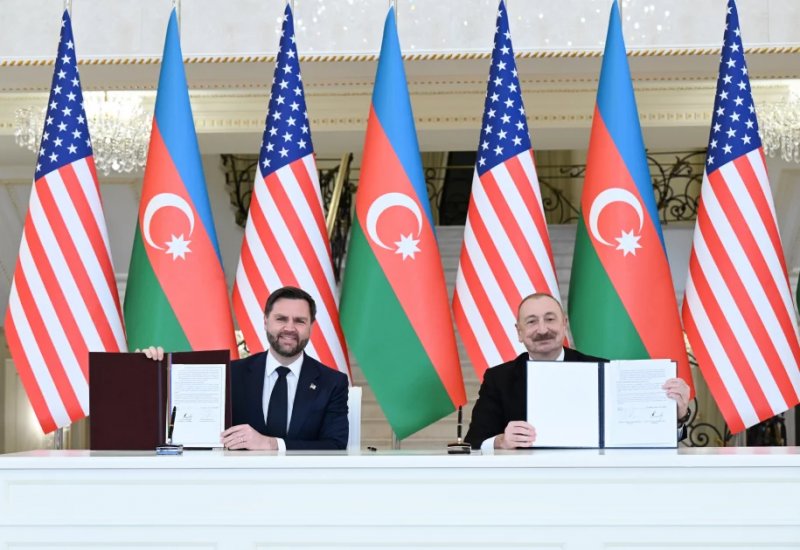
The Charter on Strategic Partnership between Azerbaijan and the United States, signed in Baku on February 10, 2026, during Vice President JD Vance's visit, marks the start of a fundamentally new phase in bilateral relations. For Azerbaijan, the agreement offers an opportunity to diversify its foreign policy, reduce its reliance on Russia, and strengthen its position in key areas such as energy, technology, and security.
The Charter outlines several significant advantages. A central pillar of the document is support for the Middle Corridor (Trans-Caspian Transport Corridor) and the TRIPP (Trump Route for International Peace and Prosperity) initiative, both aimed at enhancing transit routes, trade flows, and energy connectivity. These projects are expected to attract American investment in artificial intelligence, digital infrastructure, and energy security. The resulting expansion of new markets could create thousands of jobs and contribute to GDP growth.
RECOMMENDED STORIES
Beyond infrastructure and transit, the agreement opens the door for Azerbaijan to modernize its economy and boost competitiveness. Cooperation in information technology, artificial intelligence, and biotechnology will facilitate the exchange of expertise and innovation. The Charter also envisions expanded U.S. arms sales and collaboration in cybersecurity, counterterrorism, and mine clearance. This will strengthen Azerbaijan’s defense capabilities while providing Washington with a strategic partner capable of counterbalancing Iran in the region.
 Photo: AZERTAC
For the first time in the history of bilateral relations, Azerbaijan-U.S. ties have reached such an unprecedented level. To understand the significance of this milestone, it is important to recall the trajectory that led to its signing. Under Joe Biden, relations between the two countries deteriorated sharply, arguably reaching their lowest point since Azerbaijan gained independence. At that time, U.S. policy was widely perceived in Baku as hostile. Washington was seen as disregarding Azerbaijan’s interests in negotiations with Armenia and exerting pressure through public statements viewed as favoring Yerevan.
Sanctions rhetoric in Congress, coupled with then-Secretary of State Antony Blinken’s perceived closeness to Armenian advocacy groups, further strained relations. Azerbaijan felt that its efforts to restore sovereignty over its territories were met with criticism and threats. This period left considerable diplomatic damage and deep disappointment.
With the election of Donald Trump, U.S. foreign policy toward the South Caucasus shifted to a more pragmatic approach. The region regained strategic attention in Washington. During his meeting with President Ilham Aliyev, Vice President Vance acknowledged that the previous administration had made mistakes, including what he described as a short-sighted policy toward Azerbaijan. He emphasized that under President Trump’s leadership, those errors had been addressed. This statement symbolized the opening of a new chapter in bilateral ties.
President Ilham Aliyev also played a key role in restoring relations, recognizing shifts in the global environment and presenting Washington with a pragmatic and mutually beneficial agenda. The Charter itself reflects this practical approach, focusing on tangible outcomes rather than rhetoric.
For Azerbaijan, the agreement offers the chance to convert years of diplomatic efforts into measurable gains — investment inflows, advanced technologies, strengthened defense capacity, and greater political leverage. For the United States, it signifies a reliable and influential partner in a strategically important region. At the same time, the Charter embodies deep mutual trust and a long-term strategic vision aimed at enhancing stability and security in the South Caucasus.
The signing of the Charter also reflects Azerbaijan’s evolving role in the changing global order. The country has positioned itself at the crossroads of Europe, Central Asia, and the Middle East, gaining importance amid shifting energy and transport routes and growing competition over Eurasian transit corridors. Azerbaijan is defining its own strategic priorities, and this agreement reinforces its leading position in the emerging geopolitical landscape of the South Caucasus.
Importantly, the partnership extends beyond political dialogue to large-scale economic and infrastructure cooperation. For Azerbaijan, engagement with a global power such as the United States provides a pathway for accelerated modernization. Strategically, it may also enhance Baku’s position in addressing international disputes and regional challenges. The United States now presents itself as both a guarantor of the advancing Armenia-Azerbaijan peace process and a significant investor in technology, while recognzing Azerbaijan as an independent and equal partner.
During the signing ceremony, President Aliyev described the Charter as the culmination of intensive diplomatic work. He characterized the agreement as a major achievement of Azerbaijan’s foreign policy strategy, noting that becoming a strategic partner of the United States is a matter of national honour.
 Photo: Azernews
The new phase of cooperation could eventually lead to the repeal of Section 907 of the Freedom Support Act, which restricts direct U.S. government assistance to Azerbaijan. Given that the Charter envisions expanded defense and security cooperation, including arms sales, the existence of Section 907 appears increasingly inconsistent with the new framework of relations. Its removal may therefore be only a matter of time.
Overall, the Charter establishes a durable strategic platform that could play a stabilizing role across Eurasia. It marks a transition from episodic cooperation to a structured, long-term, and mutually beneficial partnership. This framework is supported not only by political declarations but also by concrete projects, implementation mechanisms, and institutionalized channels for dialogue.
In conclusion, the signing of the Charter on Strategic Partnership between Azerbaijan and the United States is poised to strengthen Azerbaijan’s global standing, stimulate economic growth, facilitate technological advancement, and enhance national security. It represents a concrete step by both Baku and Washington toward reinforcing regional stability and building a sustained partnership grounded in mutual trust and strategic alignment. A new geopolitical reality is emerging in the South Caucasus — one in which Azerbaijan plays a central role and its relationship with the U.S. enters a transformative new stage.
(If you possess specialized knowledge and wish to contribute, please reach out to us at opinions@news.az).


Similar news