Why Trump and Zelensky met now


Editor's note: Seymur Mammadov, a special commentator for News.Az, is the director of the international expert club EurAsiaAz. The article reflects the author’s personal opinion and does not necessarily represent the views of News.Az.
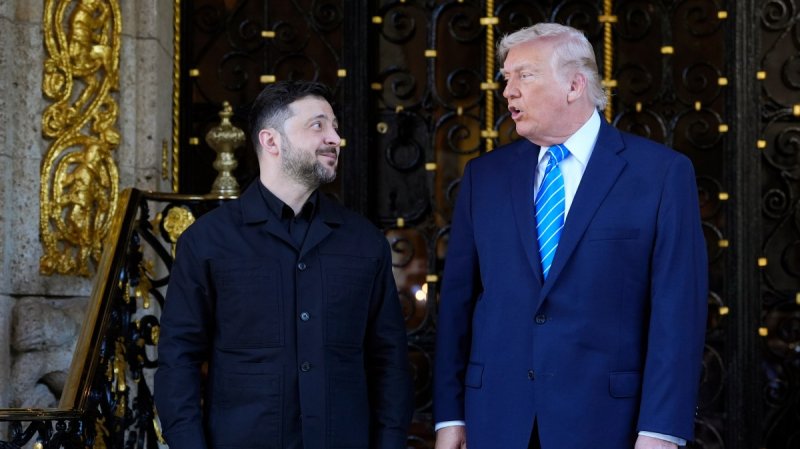
The meeting between U.S. President Donald Trump and Ukrainian President Volodymyr Zelensky on December 28, 2025, at Trump’s Mar-a-Lago estate in Florida instantly became one of the most closely watched diplomatic events of the year. While global media stopped short of calling it a breakthrough, the encounter marked a turning point — a shift from stalemate toward the early outlines of a potential negotiation framework around the war in Ukraine.
The need for the meeting is rooted in the broader geopolitical context: a protracted war approaching its fourth year, growing fatigue among Western societies, debates within the U.S. Congress, rising calls for diplomacy in Europe, and a global economy increasingly sensitive to instability in Eastern Europe.
For Washington, the end of 2025 came with mounting pressure to show tangible progress on the conflict. The United States cannot afford an indefinite war — politically, financially, or strategically — especially as domestic divisions deepen and isolationist voices gain traction. Trump, having returned to the White House, needed to demonstrate that he could achieve what neither Biden nor Brussels had delivered: a visible pathway toward a peace settlement.
For Zelensky, the meeting was equally critical. It signaled to partners that Ukraine remains a sovereign actor capable of shaping the diplomatic agenda rather than merely reacting to events. It also allowed him to reinforce allied support, show readiness for dialogue, and underline that Kyiv seeks peace, but not at the expense of national interests.
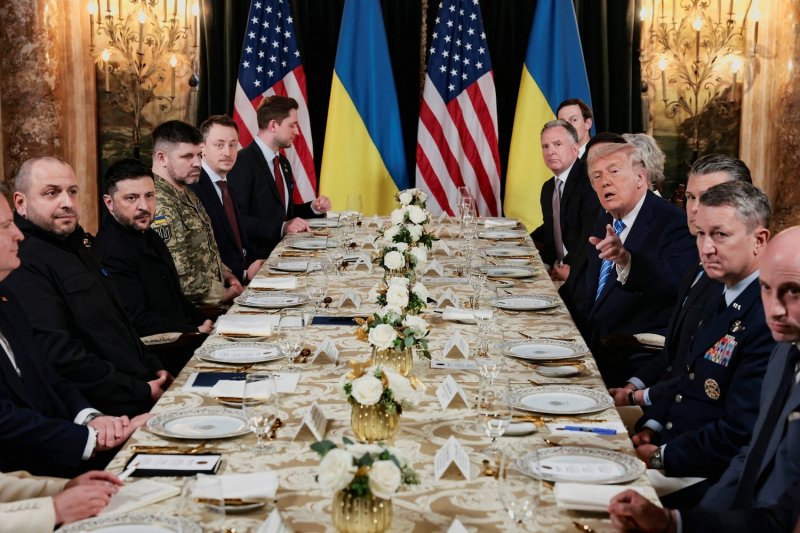 Photo: Reuters
The talks reportedly lasted several hours and centered on Ukraine’s proposed peace plan — a 20-point document previously presented to partners. Zelensky said all points had been agreed on “100%,” while Trump described the progress as “90–95%,” noting that some issues remain “very difficult.” Analysts highlighted a recurring message from both leaders: most of the groundwork is done, but the hardest part remains unresolved. At the core of the unresolved matters lie the future of Donbas, territorial boundaries, and the terms under which compromises, if any, could be considered. Trump stated that the United States is prepared to participate in a security guarantee mechanism, but territorial matters must reflect the will of the Ukrainian people while taking Moscow’s position into account.
Security guarantees were among the most intensely discussed components. The concept includes a multi-layered architecture in which the U.S., NATO countries, and major European states could commit to protecting Ukraine from future aggression. Discussions reportedly touched on long-term defense commitments, monitoring missions, arms supply formats, and rapid response obligations in the event of renewed hostilities. In Eastern Europe, such guarantees are seen not only as protection for Ukraine but also as a precedent for a new security order on the c ontinent.
Unofficial sources suggested that the idea of a referendum on disputed territories surfaced as a potential tool within a wider settlement framework — a politically sensitive notion for Kyiv but increasingly discussed among mediators as a possible diplomatic option if a peace deal is reached.
European commentators cautiously speculated that Washington might be testing models that allow Moscow to claim political success without undermining Ukraine’s sovereign future. Officially, Kyiv maintains its stance: no recognition of territorial seizures and no concessions on sovereignty. This remains the thinnest and most dangerous line — one that could determine whether negotiations succeed or collapse.
Although Russia was not physically present at the meeting, its shadow loomed over every discussion. Prior to the talks, Trump held a phone conversation with Vladimir Putin — a detail widely reported by Reuters and the Associated Press. Analysts interpreted the call as a preliminary probe: could Moscow be drawn into a future negotiation track, and under what conditions?
Meanwhile, Russia continues missile strikes on Ukrainian cities and infrastructure — a military reality that strengthens its bargaining posture. Reports in The Financial Times and The Guardian likened the Mar-a-Lago meeting to a strategic chess match: Kyiv relies on Western support and guarantees, Moscow counts on attrition and battlefield leverage, and Washington seeks to convert its influence into diplomatic progress.
International media reacted with measured optimism. Reuters noted that while no breakthrough was achieved, talks advanced “much further than many expected,” with 90–95% of the framework reportedly complete. AP observed that both leaders deliberately avoided confrontational language, speaking with an unusually unified tone interpreted as a deliberate signal to partners. The Guardian wrote that “for the first time in months there is a sense that peace is no longer abstract theory but a scenario discussed with concrete points rather than slogans.”
European press coverage was more cautious, emphasizing that any agreement must eventually involve Russia. Without Moscow, analysts warn, the conflict could simply freeze — guarantees included, but without closure.
Russian media, by contrast, focused almost entirely on the territorial dimension. Several outlets claimed Kyiv may consider compromises on Donbas — something Ukraine denies. However, the mere fact that territorial issues are labeled “difficult” suggests they are indeed on the table. Analysts in Moscow argued that Russia will likely seek to strengthen its negotiating position through continued military pressure, while the U.S. will try to maintain momentum within a diplomatic arena. The dynamic resembles a long chess endgame, with each side calculating several moves ahead, waiting for the other to blink.
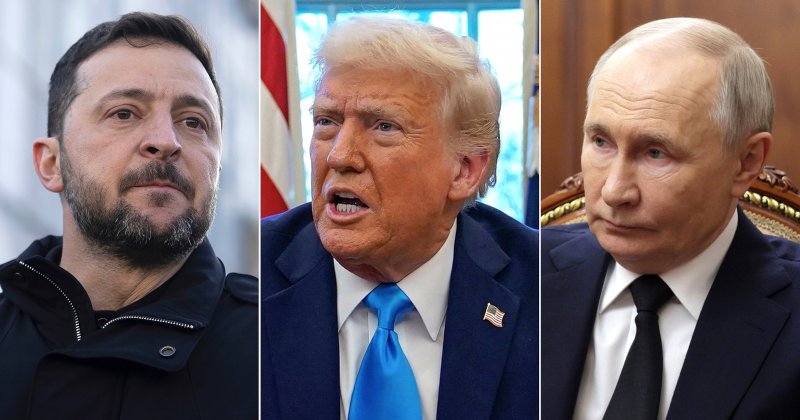 Photo: ABC News
It is important to note that this meeting is not an endpoint but the start of a process. The coming weeks will determine whether the Mar-a-Lago discussions evolve into formal negotiation tracks. If technical teams continue working, Europe engages more actively, and Russia eventually participates, a structured peace framework could emerge in 2026.
If any side concludes it is still premature, the window may close, and military logic could once again dominate. The significance of the meeting lies in the fact that the mechanism of diplomacy — long stalled — has begun to move: slowly, with friction, but undeniably forward. In global politics, movement itself is often the first victory.
That is why the meeting between Donald Trump and Volodymyr Zelensky mattered. No peace deal was signed. No hardest decisions were resolved. But in a world exhausted by war, sometimes the starting point is more important than the finish line. The December conversation in Florida will be remembered either as a symbolic gesture or as the moment when peace began to transform from distant hope into a negotiable concept. History may one day view late 2025 as the instant when diplomacy resurfaced as a viable path, and when both Kyiv and Washington publicly acknowledged that talking about peace is not capitulation, but strategy.
Whether this process succeeds depends on what follows. If the next round of talks expands, if Moscow enters dialogue, and if guarantees solidify into treaties, this meeting could one day be seen as the beginning of the end of the war. If not, analysts fear a return to escalation and uncertainty. For now, however, one fact remains: diplomacy is back in play. And that alone gives the world a reason to watch closely.
(If you possess specialized knowledge and wish to contribute, please reach out to us at opinions@news.az).


Similar news