Europe seeks a way to get by without the U.S.


Europe’s confidence in the United States as its long-standing security guarantor has been steadily weakening. The policies of the current U.S. administration are increasingly convincing European leaders that the era in which Washington served as an unquestioned protective umbrella for the continent may be drawing to a close.
President Donald Trump’s approach to foreign policy is increasingly seen as diverging from Europe’s strategic interests. Whereas previous U.S. administrations were viewed as taking allied concerns into account, Trump is portrayed as acting with less regard for European positions.
Against this backdrop, European allies are increasingly being left on their own to deal with the consequences of Russia’s war against Ukraine. This concern is heightened by a recent bill passed in the State Duma, which expands provisions for the use of Russian armed forces abroad under the pretext of protecting Russian citizens. The amendments allow for military force to be used in cases involving detained Russian nationals in foreign countries.
At the height of tensions in the Middle East, Trump once again raised the possibility of the United States withdrawing from NATO amid disagreements with allies over Iran. NATO has long served as Europe’s primary security umbrella against threats from the East. However, a U.S. withdrawal from the alliance could, in theory, lead to its fragmentation, given that the United States accounts for roughly 60 percent of NATO’s overall military capability.
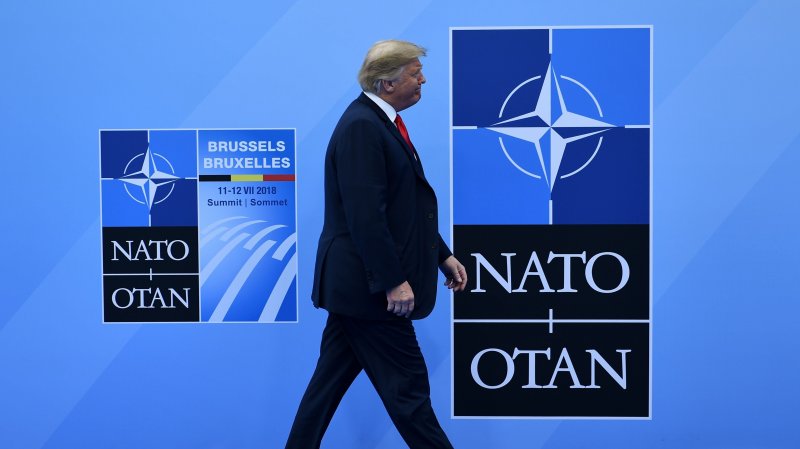
Media reports suggest Trump was dissatisfied that several NATO members did not support the U.S. during its operation against Iran. He is said to be particularly displeased with France, Spain, and the United Kingdom, while expressing approval of countries such as Poland, Romania, Lithuania, and Greece for showing solidarity. Later reports indicated that rather than a full withdrawal from NATO, Washington may consider repositioning its forces — reducing troop levels in countries deemed less cooperative while strengthening its presence in those more aligned with U.S. policy.
Analysts, however, argue that such statements are largely rhetorical and would have limited immediate practical impact, noting that troop redeployments take time. Trump’s final position may also be influenced by outcomes of the upcoming NATO summit in Türkiye in July, where discussions are expected to include proposals to raise defense spending to 5 percent of GDP, according to Izvestia.
Despite the rhetoric, most observers do not see a realistic near-term prospect of the U.S. leaving NATO. Analysts largely consider a full withdrawal unlikely, but stress that even the suggestion of such a move is already reshaping dynamics within the alliance, and significantly so.
As a result, European governments are increasingly exploring contingency plans for a scenario in which U.S. commitment to NATO is reduced. According to The Wall Street Journal, Europe is quietly preparing a backup framework in case Trump either scales back American participation or withdraws from the alliance entirely. The idea reportedly centers on strengthening European leadership within NATO, with some informal references to a “European NATO” concept.
One EU official told Politico that the possibility of NATO’s collapse is “absolutely obvious,” adding that “we can’t wait for it to die completely.”
According to the report, two main formats are being discussed within Europe.
The first is the Joint Expeditionary Force (JEF), a British-led rapid response coalition involving several Northern European countries. The JEF operates independently of NATO’s Article 5 framework in certain scenarios and focuses on fast deployment capabilities. Ukraine has already entered an enhanced partnership arrangement with the JEF, and Canada is also seen as a potential future participant.
The second is NORDEFCO, the Nordic Defence Cooperation framework, which includes Denmark, Finland, Iceland, Norway, and Sweden. This format focuses on regional military coordination among Nordic states.
At the EU level, Brussels has allocated €150 billion in defense loans to member states. Officials are also examining Article 42(7) of the EU Treaty, which contains a mutual defense clause. In addition, a new economic security strategy is expected later this summer, according to Politico.
The International Institute for Strategic Studies (IISS) has also analyzed possible scenarios for a NATO operating without the U.S., urging European policymakers to assess the military, financial, and industrial investments required to reduce dependence on Washington and prepare for worst-case outcomes. A previous IISS assessment of a “NATO without the US” concluded with notably pessimistic findings.
As reported by DW, the study identified serious capability gaps that would emerge without U.S. involvement, particularly in areas such as advanced military platforms, personnel capacity, space operations, intelligence, surveillance, and reconnaissance systems. It also highlighted the extent of U.S. contributions to NATO command structures and senior leadership roles, many of which are currently filled by American personnel. According to the analysis, compensating for these losses could require approximately $1 trillion in additional spending from European NATO members, on top of already rising defense budgets.
Over decades of US-led security arrangements, Europe has significantly reduced its own independent defense capabilities. Since the end of large-scale wars on the continent, European states have largely delegated security responsibilities to Washington — driven not purely by choice, but by geopolitical necessity and the perceived need to balance dependence on the U.S. against threats from the East.
Had different strategic choices been made earlier, Europe’s current security architecture might look very different today.
By Tural Heybatov


Similar news