Why Hakan Fidan is heading to Moscow


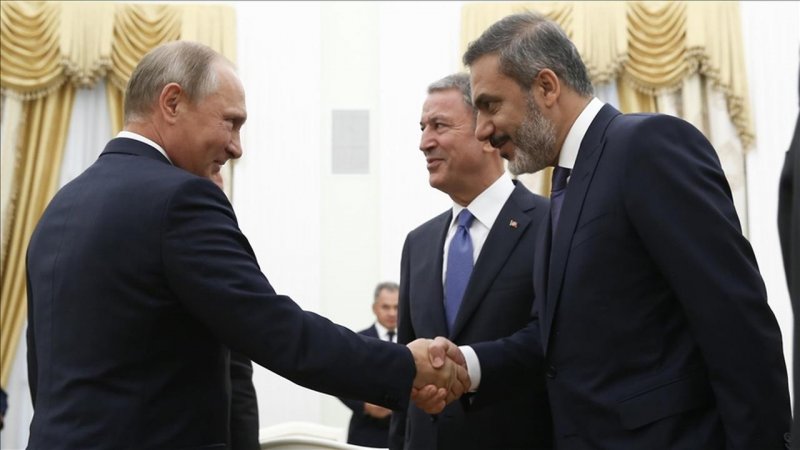
Turkish Foreign Minister Hakan Fidan is expected to visit Moscow on 15–17 June. According to media reports, he is scheduled to hold talks with Russian Foreign Minister Sergey Lavrov, along with a number of other bilateral meetings.
The visit appears to be far more significant than routine bilateral consultations. Officially, the agenda centres on negotiations with Lavrov, but the current international environment suggests that Ankara and Moscow have a much broader range of issues to discuss than merely bilateral relations. The two sides are expected to coordinate their positions on the Middle East and the South Caucasus.
Analysts do not rule out the possibility that the Ukraine issue will also be discussed. Türkiye has emerged as one of the key and most active mediators in the Russia–Ukraine conflict, leveraging its geographical position and its unique status as the only NATO member maintaining working relations with both sides. In recent years, Ankara has facilitated numerous contacts involving prisoner exchanges, the grain deal and various negotiation initiatives between the warring parties.
Officials from multiple countries, including Russia and Ukraine themselves, have repeatedly expressed their willingness to view Ankara as a potential diplomatic mediator in the peace process. At the same time, Turkish leaders, particularly President Recep Tayyip Erdoğan, have emphasised their commitment to achieving a “just and lasting peace”.
RECOMMENDED STORIES
For Türkiye, maintaining its status as an indispensable mediator is important, while for Russia, preserving a channel of communication with the West through a NATO member remains valuable.
The Syrian issue is also expected to feature prominently in the discussions. Moscow and Ankara's interests in Syria combine intense rivalry with pragmatic cooperation. Both sides seek to avoid a direct clash of interests and further destabilisation in the country. Following shifts in the regional balance of power and the ongoing transformation of Syria’s political landscape, Moscow and Ankara once again find themselves needing to reconcile their interests.
Turkish media emphasise that Ankara is particularly concerned about the Kurdish factor and the activities of groups linked to the PKK in northern Syria. Russia, meanwhile, seeks to preserve what remains of its influence in Syria and prevent its complete exclusion from the region. Fidan is widely regarded as one of the architects of Türkiye’s security policy towards Syria, making him a key figure in conducting the most sensitive negotiations with Russia on this issue.
The South Caucasus will also be high on the agenda, particularly in light of the situation following Armenia’s parliamentary elections. It has already been officially confirmed that the ministers will discuss developments in the region.
For Türkiye, priorities in the South Caucasus include further strengthening its strategic alliance with Azerbaijan, advancing regional transport projects, addressing the issue of reopening communications between Azerbaijan and Armenia, and helping shape the future regional security framework following the effective weakening of Russia’s position in the region.
It should be recalled that 15 June marks the fifth anniversary of the Shusha Declaration, signed in 2021, which formalised the strategic partnership and mutual military assistance commitments between Ankara and Baku.
As a result, Türkiye enjoys a strong position in the South Caucasus through its alliance with Azerbaijan. Russia, meanwhile, is rapidly losing influence after seeing Armenia move away from its traditional role as Moscow’s regional outpost. Russia is now searching for ways to preserve its influence in the South Caucasus amid Armenia’s distancing and Türkiye’s growing role.
Although Western powers are also seeking to expand their presence in the region, most observers acknowledge that Turkish influence is likely to continue growing.
Against this backdrop, the talks between Fidan and Lavrov may represent an attempt to establish new rules of coexistence between Russia and Türkiye in the South Caucasus following the end of the Karabakh conflict and the broader geopolitical changes that have reshaped the region.
Despite political disagreements, Russia and Türkiye continue to maintain extensive economic cooperation. This relationship has remained largely unaffected by geopolitical turbulence.
Key areas of cooperation include Russian natural gas supplies, Türkiye’s ambitions to become a regional gas hub, the Akkuyu Nuclear Power Plant project, trade in national currencies and Black Sea logistics routes that remain critically important for Russia.
Ankara faces a delicate balancing act: preserving the economic benefits of cooperation with Russia while avoiding secondary sanctions. So far, it appears to have managed this challenge successfully. Türkiye has avoided severing ties with Russia and continues to benefit economically, while sanctions-hit Russia maintains access to vital economic channels through this cooperation.

The timing of Fidan’s visit — just ahead of the NATO summit — is also noteworthy.
Ankara has consistently sought to demonstrate its strategic independence. It pursues a multi-vector foreign policy and regularly signals this approach to all major centres of power. While remaining a NATO member, Türkiye simultaneously demonstrates its ability to engage in independent dialogue with Moscow, regardless of the views of Washington or Brussels. For Erdoğan, this is a crucial element of Türkiye’s positioning as an autonomous centre of power in international affairs. Consequently, Fidan’s visit also serves as a message to Türkiye’s Western partners that Ankara intends to continue pursuing this policy.
Today, Türkiye’s primary objective is to avoid a direct clash of interests with Russia — whether in Syria or the South Caucasus — while preserving and expanding its growing influence across Eurasia. Ankara acts cautiously and deliberately, avoiding abrupt moves despite being one of the leading powers in the region, a reality that is well understood in both Moscow and Washington.
Thus, Fidan’s visit to Moscow should not be viewed as a routine diplomatic trip, but rather as an element of geopolitical coordination between two powers whose relationship can best be summarised by the phrase: “neither fully with each other, nor able to do without each other.”
By Tural Heybatov


Similar news