Judge refuses to block Trump’s mail-in voting executive order


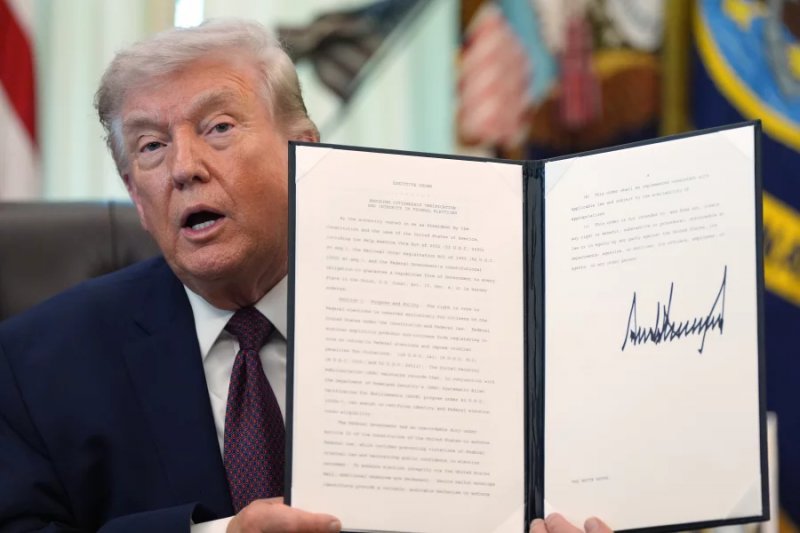
A federal judge in Washington, D.C., has declined to temporarily halt a controversial executive order from President Trump aimed at restricting mail-in voting.
The decision, handed down Thursday by U.S. District Judge Carl Nichols—a Trump appointee—leaves the sweeping directive in place for now. The ruling marks a temporary victory for the administration, whose previous 2025 executive order on voting was successfully blocked by the courts, News.Az reports, citing NPR.
The latest order, signed on March 31, significantly tests the constitutional boundaries of presidential authority over elections. It directs the Department of Homeland Security and the Social Security Administration to compile lists of adult U.S. citizens to hand over to state election officials. Furthermore, it instructs the U.S. Postal Service (USPS)—an independent federal agency—to create its own eligible voter lists and only deliver mail-in ballots to the individuals named on them.
RECOMMENDED STORIES
Why the judge declined to block the order
In his ruling, Judge Nichols explained that the legal challenge is currently premature because federal agencies have not yet fully rolled out the new restrictions.
"The Court recognizes that the Postal Service may ultimately issue a final rule that directly affects Plaintiffs... or that the Government may develop State Citizenship Lists that omit specific individuals," Nichols wrote. "Plaintiffs may, of course, renew their motions if and when those future actions occur. Until then, however, Plaintiffs cannot show that preliminary injunctive relief is warranted."
The administration has admitted in recent court filings that federal agencies are still deliberating exactly how to execute the mandate. However, Acting U.S. Attorney General Todd Blanche recently assured a Senate Appropriations subcommittee that the Justice Department is actively working with other agencies to ensure the order's goals are fully implemented.
Constitutional showdown looms
The executive order has sparked fierce resistance, triggering five separate lawsuits from Democrats, voting rights groups, Washington, D.C., and nearly two dozen states.
The core arguments against Trump's directive include:
Constitutional Overreach: Opponents argue that Article I of the U.S. Constitution explicitly grants state legislatures and Congress—not the executive branch—the power to set federal election rules.
Postal Service Mandate: The lawsuits claim the order forces the USPS to create election regulations that far exceed the agency's legal authority.
President Trump, who ironically cast his own ballot by mail in Florida this past March, has heavily defended the order. He maintains the restrictions are necessary to prevent noncitizens from voting in federal elections, a phenomenon that extensive research and historical reviews show is exceptionally rare.
While mail-in voting is widely used across the political spectrum, the policy has major partisan implications; data from the 2024 national election shows that significantly more registered Democrats than Republicans chose to vote by mail.
The legal battle is far from over. While this ruling addresses three lawsuits filed in Washington, D.C., another federal judge in Boston is currently reviewing two similar lawsuits and is expected to rule on whether to block the order by early June.
By Aysel Mammadzada


Similar news