New great game: Critical minerals become Central Asia's most strategic asset


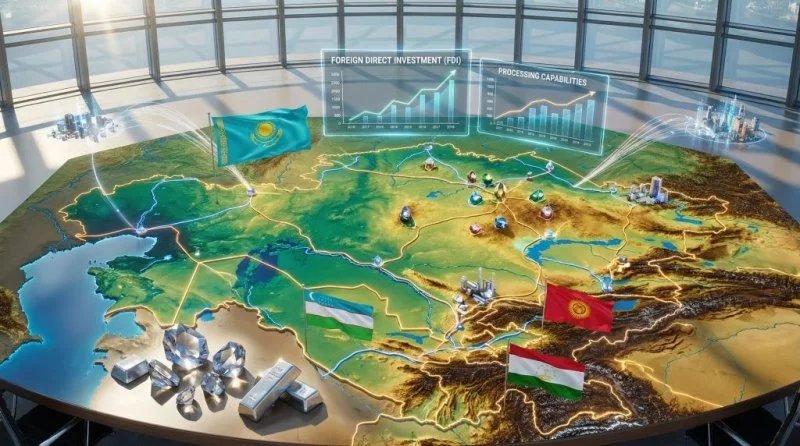
Central Asia is rapidly emerging as one of the world's most important regions for critical minerals, placing Kazakhstan, Uzbekistan, Kyrgyzstan and other countries at the center of a growing global competition among major powers.
As governments and companies race to secure supplies of materials essential for electric vehicles, renewable energy technologies, semiconductors, batteries and advanced defense systems, the region's vast mineral wealth has become a major geopolitical and economic story, News.az reports.
Over the past few days, discussions about critical minerals, foreign investment and industrial development have dominated policy debates across Central Asia, highlighting the region's growing importance in the global economy.
What are critical minerals and why are they important?
Critical minerals are raw materials considered essential for modern industries and national security. They are used in the production of electric vehicle batteries, solar panels, wind turbines, smartphones, computer chips, military equipment and artificial intelligence infrastructure.
Unlike traditional commodities such as oil and natural gas, many critical minerals are concentrated in a relatively small number of countries. This makes supply chains vulnerable to geopolitical tensions, trade disputes and export restrictions.
As countries accelerate the transition to cleaner energy and advanced technologies, demand for these materials is expected to increase dramatically. Governments around the world are therefore searching for reliable suppliers capable of supporting long-term industrial growth.
This growing demand has transformed critical minerals into one of the most strategically important resources of the 21st century.
Why is Central Asia attracting so much attention?
Central Asia possesses significant deposits of uranium, copper, lithium, rare earth elements, tungsten, molybdenum and other strategically important minerals.
For decades, much of the region's economic potential remained underdeveloped due to limited infrastructure, investment shortages and geopolitical isolation. However, global demand for critical minerals is changing that reality.
International companies and governments increasingly view Central Asia as an alternative source of strategic materials at a time when many countries are seeking to diversify supply chains and reduce dependence on a small number of dominant producers.
The region's location between Europe and Asia also enhances its attractiveness. New transport corridors and logistics projects are helping connect Central Asian mineral resources to international markets more efficiently than ever before.
As a result, the region is attracting growing attention from investors, policymakers and multinational corporations.
Which countries hold the most valuable resources?
Kazakhstan is widely considered the region's mineral powerhouse. The country is already the world's leading producer of uranium and possesses substantial reserves of copper, chromium, manganese and rare earth elements.
The government has launched multiple initiatives aimed at attracting foreign investment into mining, processing and value-added manufacturing industries. Officials hope to move beyond simply exporting raw materials and instead develop domestic industrial capacity.
Uzbekistan is also emerging as a major player. The country possesses significant deposits of copper, gold, silver, tungsten and rare earth minerals. Authorities are actively pursuing investment partnerships designed to modernize mining operations and increase exports.
Kyrgyzstan and Tajikistan possess valuable mineral resources as well, although their industries remain smaller. Nevertheless, growing global demand is creating new opportunities for exploration and development projects throughout the region.
Together, these countries are positioning themselves as important suppliers in the evolving global resource economy.
Why are major powers interested in Central Asia's minerals?
The growing competition for critical minerals is largely driven by concerns over supply chain security.
The United States, European Union, China, Türkiye, South Korea, Japan and other economies all require increasing quantities of strategic minerals to support industrial production and technological development.
Governments worry that excessive dependence on a limited number of suppliers could create economic vulnerabilities or expose industries to geopolitical risks.
Central Asia offers an opportunity to diversify sourcing strategies while securing access to materials necessary for future economic growth.
As a result, investment missions, trade agreements and strategic partnerships involving Central Asian mineral projects have increased significantly in recent years.
For many countries, access to critical minerals is becoming as important as access to oil and gas was in previous decades.
How could critical minerals transform Central Asian economies?
The economic potential is enormous.
Mining projects can generate billions of dollars in export revenue, create employment opportunities and attract foreign investment. Governments view the sector as a key driver of economic diversification and industrial modernization.
However, policymakers increasingly emphasize that simply exporting raw materials is no longer sufficient.
Instead, many countries aim to develop processing facilities, refining industries and manufacturing sectors that can capture more value domestically. Producing battery components, refined metals and advanced industrial materials could significantly increase economic returns compared with exporting unprocessed ores.
This approach could help create higher-paying jobs, strengthen technological capabilities and reduce dependence on traditional commodity exports.
For Central Asia, critical minerals are increasingly viewed not merely as natural resources but as a foundation for broader economic transformation.
What challenges does the region face?
Despite its enormous potential, the sector faces several obstacles.
Infrastructure remains one of the biggest challenges. Many mineral deposits are located in remote areas requiring new roads, railways, power systems and logistics facilities before large-scale development becomes economically viable.
Environmental concerns also represent a major issue. Mining operations can affect water resources, ecosystems and local communities if not managed responsibly.
In addition, governments must ensure that revenues generated from natural resources contribute to long-term development rather than creating economic dependence on commodity exports.
Regulatory transparency, investor confidence and workforce development are also essential for attracting international investment and ensuring sustainable growth.
Successfully addressing these challenges will determine whether the region can fully capitalize on its mineral wealth.
How does the global energy transition affect Central Asia?
The shift toward renewable energy and electric transportation is dramatically increasing demand for many critical minerals.
Electric vehicle batteries require large quantities of lithium, nickel, cobalt and copper. Wind turbines and solar panels depend on rare earth elements and other specialized materials. Data centers, artificial intelligence infrastructure and advanced electronics require a wide range of strategic metals.
As countries invest heavily in clean energy technologies, demand for these materials is expected to remain strong for decades.
This creates a historic opportunity for Central Asian producers to become key suppliers in the global green economy.
Many experts believe the region could play a role in the energy transition comparable to the role Middle Eastern countries played during the age of oil.
What does this mean for the region's future?
The growing importance of critical minerals is reshaping Central Asia's geopolitical and economic position.
Countries that successfully develop their resources could attract substantial foreign investment, strengthen industrial capabilities and gain greater influence in international markets.
At the same time, competition among external powers for access to these resources is likely to intensify. Governments will need to carefully balance relationships with multiple partners while protecting national interests and maximizing economic benefits.
The challenge will be transforming mineral wealth into sustainable development rather than simply exporting raw materials.
If managed effectively, critical minerals could become one of the most powerful engines of growth in Central Asia over the coming decades.
The Bottom Line
Critical minerals have become Central Asia's newest strategic asset as global demand for resources essential to clean energy, advanced manufacturing and digital technologies continues to rise. With vast reserves and increasing international interest, the region is positioning itself at the center of a new global competition for resources—one that could redefine its economic future and geopolitical importance.
By Faig Mahmudov


Similar news