What Is Behind the Belfast Riots?


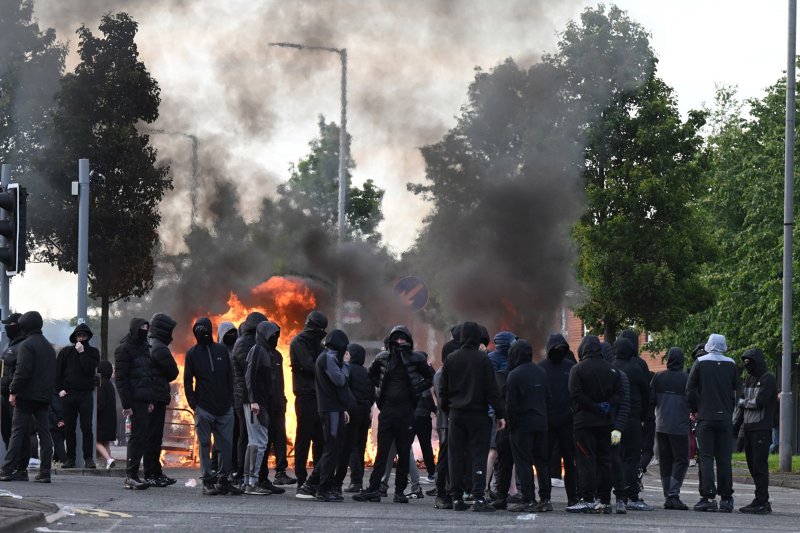
Violent unrest has erupted in Belfast following a stabbing attack that quickly became a flashpoint for wider tensions over immigration, social deprivation, and community relations in Northern Ireland.
What began as anger over a serious assault escalated into anti-immigrant violence, with homes attacked, vehicles burned, and immigrant families forced to flee for safety, News.az reports.
The riots have drawn condemnation from political leaders across the United Kingdom and reignited concerns about the influence of online misinformation, far-right activism, and deep-rooted social grievances in some of Northern Ireland’s most disadvantaged communities.
What happened in Belfast?
The violence was triggered by a stabbing attack in Belfast in which a local man suffered severe injuries. Authorities later charged a 30-year-old Sudanese refugee and legal resident with attempted murder.
As graphic footage of the attack circulated online, calls for protests began spreading across social media. Within hours, demonstrations emerged in parts of Belfast and other areas of Northern Ireland.
What initially appeared to be protests soon descended into disorder. Cars and a city bus were set on fire, roads were blocked, and masked groups targeted properties associated with immigrants. Some families were forced to flee burning homes as emergency services responded to multiple incidents.
Police deployed additional officers and later used water cannons to disperse crowds amid fears that the violence could spread further.
Was the unrest directly caused by the stabbing?
The stabbing served as the immediate trigger, but many observers argue that it was not the sole cause of the riots.
The attack created a highly emotional atmosphere, particularly after videos of the incident spread rapidly online. However, experts, community leaders, and politicians say the violence reflected broader frustrations and tensions that had been building for years.
The unrest appears to have been driven by a combination of factors, including concerns over immigration, economic hardship, social exclusion, political polarization, and online radicalization.
In this sense, the stabbing acted as a catalyst rather than the root cause.
Why did immigrants become targets?
According to police, witnesses, and local leaders, many of the attacks specifically targeted immigrants and ethnic minorities.
Several homes occupied by immigrant families were attacked, and residents reported being threatened because of their race or nationality. Community workers described scenes in which people were forced from their homes simply because they were perceived as outsiders.
Political leaders argued that some individuals exploited public anger over the stabbing to direct hostility toward immigrants who had no connection to the crime.
This pattern reflects a broader trend seen elsewhere in Europe, where individual criminal incidents involving migrants have sometimes been used by extremist groups to promote anti-immigrant narratives.
What role did social media play?
Social media appears to have been a major factor in escalating tensions.
Videos of the stabbing circulated widely online, generating outrage and attracting attention far beyond Belfast. As emotions intensified, anti-immigrant messages and calls for protests spread across multiple platforms.
Police officials warned that some online users were actively encouraging disorder and sharing information about locations linked to immigrant communities.
Authorities also expressed concern that misinformation and inflammatory rhetoric may have contributed to violence by portraying entire communities as responsible for the actions of one individual.
The speed at which information—and sometimes misinformation—spread online helped transform a local criminal investigation into a broader political and social crisis.
Who is accused of encouraging the unrest?
Authorities have not publicly identified all individuals suspected of encouraging violence, but attention has focused on far-right activists and online influencers who amplified anti-immigrant messaging after the stabbing.
Some prominent anti-immigration figures urged supporters to protest, framing the attack as evidence of broader failures in immigration policy.
Police have indicated that they are investigating both online and offline efforts to organize disorder and determine whether any individuals may have committed criminal offenses by encouraging violence.
Why is immigration such a sensitive issue in Northern Ireland?
Northern Ireland has historically been one of the least ethnically diverse parts of the United Kingdom.
For decades, public debate focused largely on divisions between unionist and nationalist communities rather than immigration. However, demographic changes since the 1998 peace agreement have brought increased migration and greater diversity, particularly in cities such as Belfast.
While many communities have adapted successfully to these changes, some areas have experienced social tensions linked to economic hardship, housing pressures, and competition for limited public resources.
These concerns can create fertile ground for anti-immigrant narratives, especially during periods of uncertainty or crisis.
How do economic conditions factor into the unrest?
Economic deprivation is widely viewed as one of the key underlying factors behind the riots.
Northern Ireland remains one of the most economically disadvantaged regions of the United Kingdom. Many communities continue to face challenges including:
- Limited employment opportunities
- Poverty
- Educational disadvantages
- Housing shortages
- Social exclusion
In neighborhoods where residents already feel neglected or left behind, frustration can sometimes be redirected toward newcomers, particularly when extremist groups portray immigration as the source of local problems.
While economists generally reject claims that immigration alone causes such hardships, perceptions often carry significant political weight.
Is there a connection to Northern Ireland’s history?
Many local leaders believe there is.
Northern Ireland's history has been shaped by decades of sectarian conflict known as "The Troubles," during which intimidation, forced displacement, and attacks on homes were common features of communal violence.
Several community representatives noted that the tactics seen during the riots—particularly forcing families from their homes—evoked painful memories of that period.
Although the current unrest is not rooted in the traditional Catholic-Protestant divide, some observers argue that old patterns of communal hostility and territorial intimidation remain embedded in parts of society.
How have political leaders responded?
Political leaders across Northern Ireland and the United Kingdom have strongly condemned the violence.
Officials described attacks on immigrant families as unacceptable and rejected attempts to justify violence because of the stabbing.
Leaders emphasized that criminal acts should be dealt with through the justice system rather than collective punishment directed at entire communities.
Calls for calm have come from across the political spectrum, reflecting widespread concern that the unrest could further damage community relations.
What impact has the violence had on immigrant communities?
The riots have created fear and uncertainty among many immigrants living in Belfast and elsewhere in Northern Ireland.
Some residents reported being afraid to return home after attacks on their properties. Others described feeling unsafe traveling to work or moving around their neighborhoods.
Healthcare workers, care staff, and other essential workers from immigrant backgrounds have spoken about concerns for their safety and the safety of their families.
Community organizations have been providing emergency support to those displaced by attacks, while local leaders have urged residents to reject racism and intimidation.
Could the unrest spread further?
Authorities have increased police deployments amid concerns that further demonstrations could occur.
The risk depends on several factors, including:
- The effectiveness of policing efforts
- The spread of online misinformation
- Political messaging from community leaders
- The outcome of criminal proceedings related to the stabbing
- Whether extremist groups continue mobilizing supporters
Officials have warned that attempts to organize further attacks online are being closely monitored.
What does the Belfast unrest reveal about wider trends?
The riots highlight challenges that are emerging across many Western societies.
The events demonstrate how a single violent incident can rapidly escalate into broader social unrest when combined with:
- Immigration tensions
- Economic frustration
- Online misinformation
- Political polarization
- Social media mobilization
They also show how local grievances can become intertwined with national and international debates about migration, identity, and security.
What happens next?
The immediate focus remains on restoring order, protecting vulnerable communities, and investigating those responsible for violence.
Police are continuing to examine both the stabbing attack and the subsequent unrest. Authorities are also investigating individuals who may have used online platforms to encourage disorder or target specific communities.
At the same time, political leaders and community groups face a longer-term challenge: addressing the underlying social and economic conditions that contributed to the unrest while rebuilding trust between communities.
The Belfast riots were sparked by a stabbing attack, but they have exposed deeper tensions surrounding immigration, inequality, and social cohesion. Whether those tensions ease or intensify will depend largely on how authorities, community leaders, and society as a whole respond in the weeks and months ahead.
By Faig Mahmudov


Similar news