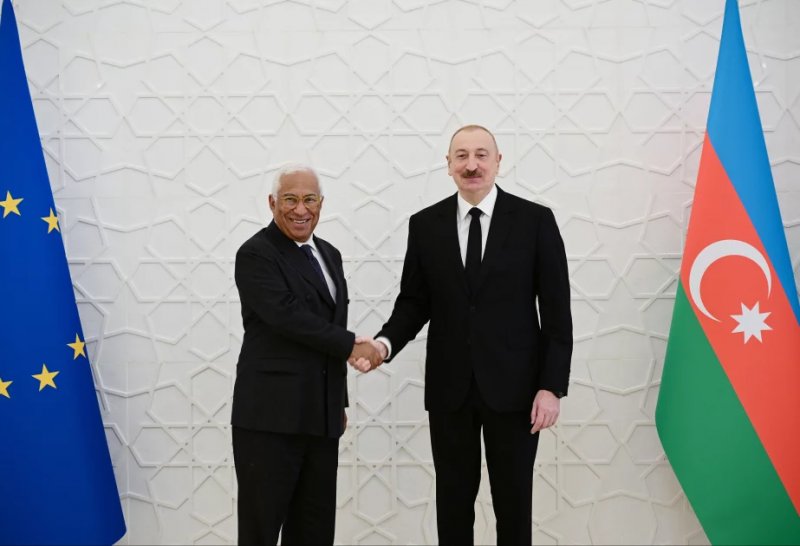
According to a joint press statement, the two leaders emphasized the strategic importance of the Azerbaijan–EU partnership and expressed readiness to deepen political dialogue and practical cooperation, News.Az reports, citing AZERTAC.
They noted the positive momentum generated by recent high-level meetings, particularly in the fields of security, energy and transport.
The presidents stressed that the partnership reflects the shared interests of both sides and contributes to peace, stability, connectivity and sustainable development across the wider Black Sea, South Caucasus and Central Asia regions.
They reaffirmed that relations between Azerbaijan and the EU are based on mutual respect, equality and shared benefit, in full respect of the Charter of the United Nations and international law, including the sovereignty and territorial integrity of states.
Aliyev and Costa also reiterated their commitment to the swift conclusion of negotiations on a new comprehensive bilateral agreement that would provide a solid legal framework for further development of relations. They highlighted the importance of adopting renewed Azerbaijan–EU Partnership Priorities and fully utilizing existing dialogue mechanisms, including the Azerbaijan–EU Cooperation Council, to advance cooperation across all areas.
The leaders reaffirmed their shared objective of achieving a peaceful, stable, interconnected and prosperous South Caucasus free of dividing lines. They welcomed recent positive developments in the region, particularly the historic momentum in the Azerbaijan–Armenia peace process. Both sides also welcomed the outcomes of the August 8, 2025 Washington Summit and the subsequent steps toward normalization between Azerbaijan and Armenia. The President of the European Council reiterated the EU’s full support for efforts by both countries to achieve sustainable peace through bilateral dialogue.
The presidents also highlighted Azerbaijan’s large-scale post-conflict reconstruction and development efforts in the Garabagh and Eastern Zangezur regions. Acknowledging the scale of challenges, especially landmine contamination, they called for increased international support and noted that the European Union remains the leading international donor in humanitarian de-mining efforts.
Aliyev and Costa emphasized that the implementation of the “Azerbaijan 2030: National Priorities for Socio-Economic Development” creates new opportunities to expand cooperation between Azerbaijan and the EU in areas such as trade, connectivity, investment, economic resilience and clean energy.
They also underscored Azerbaijan’s important role in regional connectivity, particularly through the Middle Corridor, which strengthens transport, trade, energy and digital links between the Black Sea, the South Caucasus and Central Asia.
The EU reaffirmed its commitment to cooperation with Azerbaijan on connectivity projects under the Global Gateway initiative and other mechanisms, including support for railway modernization in the Nakhchivan Autonomous Republic and ongoing efforts related to the implementation of the TRIPP program. The leaders welcomed the creation of a High-Level Working Group on Economic Cooperation aimed at strengthening economic ties and boosting investments under the Global Gateway initiative.
Recalling their longstanding energy partnership, the presidents acknowledged Azerbaijan’s role as a reliable partner in diversifying Europe’s energy supplies and pledged to continue implementing the Memorandum of Understanding on Strategic Partnership in the energy sector signed in 2022. They highlighted the importance of the Southern Gas Corridor and the Green Energy Advisory Council and noted the potential to expand cooperation in renewable energy, including wind and solar power, as well as electricity interconnection initiatives such as the Black Sea Submarine Cable project.
The leaders also welcomed the successful outcomes of the 29th Conference of the Parties to the United Nations Framework Convention on Climate Change (COP29), held in Baku in November 2024 under Azerbaijan’s presidency, and reaffirmed their readiness to deepen cooperation on climate change and environmental protection.
They welcomed Azerbaijan’s upcoming hosting of the 13th session of the World Urban Forum in May 2026, describing it as a significant contribution to global efforts toward sustainable urbanization and resilient urban development. Both sides expressed readiness to use the forum as an opportunity to further strengthen Azerbaijan–EU cooperation in these areas.
The presidents also emphasized the importance of closer cooperation in defense and security to address emerging threats such as organized crime, terrorism, extremism, illicit trafficking in weapons and drugs, money laundering, human trafficking and irregular migration.
They underlined the growing importance of cooperation in digital transformation and innovation, including in the field of artificial intelligence and other emerging technologies, with the aim of promoting innovation, economic resilience, sustainable development and dynamic digital ecosystems.
In addition, the leaders highlighted the importance of strengthening people-to-people contacts through enhanced mobility. They welcomed the continued implementation of the Visa Facilitation Agreement to further simplify mutual travel and pledged to expand cooperation in education, culture, youth and research.
During the meeting, Aliyev and Costa also discussed key geopolitical issues, including the latest developments in Iran and Ukraine.