Russia unveils new interceptor drones to target Ukrainian UAVs


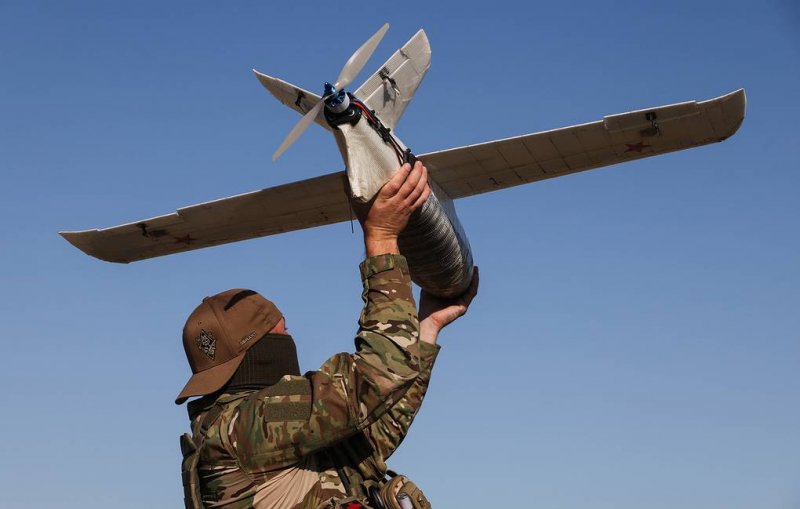
Russia has officially unveiled two new anti-aircraft interceptor drones, the Sokol-I and the Molniya-PVO, in a direct bid to counter Ukraine's highly effective drone fleet. According to a report by Defense Express, these new UAVs are specifically designed to hunt down and destroy Ukrainian aircraft like the Leleka, Bulava, and Hornet. However, military experts are already questioning whether these new weapons can actually deliver on Moscow's promises.
The Sokol-I features a lightweight foam plastic body, daytime and thermal imaging cameras for target tracking, and a maximum flight altitude of 5,000 meters. For combat, it relies on either a proximity-fused warhead or pure kinetic force to ram enemy targets out of the sky, News.Az reports, citing RBC-Ukraine.
The glaring issue? Its speed. The Sokol-I tops out at 150 km/h—the exact cruising speed of the Ukrainian Hornet drone it is meant to intercept. Because the Hornet can accelerate up to 200 km/h when closing in on a target, the Sokol-I may physically lack the speed to ever catch up. Furthermore, Russia has kept the drone's flight duration a secret, leaving it unclear how much time operators actually have to execute a successful hit.
RECOMMENDED STORIES
Details on the second drone, the Molniya-PVO, remain scarce. Based on the existing Molniya drone family, this version appears to be a scaled-down, twin-engine model capable of carrying a 1-kilogram payload. It can be hand-launched or fired from a catapult to target heavy bombers and fixed-wing UAVs, though questions about its production scale and real-world efficiency remain completely unanswered.
This rapid development highlights Russia's desperate scramble to adapt to Ukraine’s sophisticated aerial tactics. While Russian leadership continues to praise its domestic air defense capabilities, the reality on the ground tells a different story, highlighted by recent drone strikes deep within Russian territory. Experts note that intercepting modern tactical drones remains incredibly difficult, as they frequently fly just 10 to 20 meters above the ground, utilizing complex routes and natural terrain to completely bypass traditional radar systems.
By Aysel Mammadzada


Similar news