Yandex metrika counter
Dinosaur highway 'one of the longest in the world'
Photo: BBC

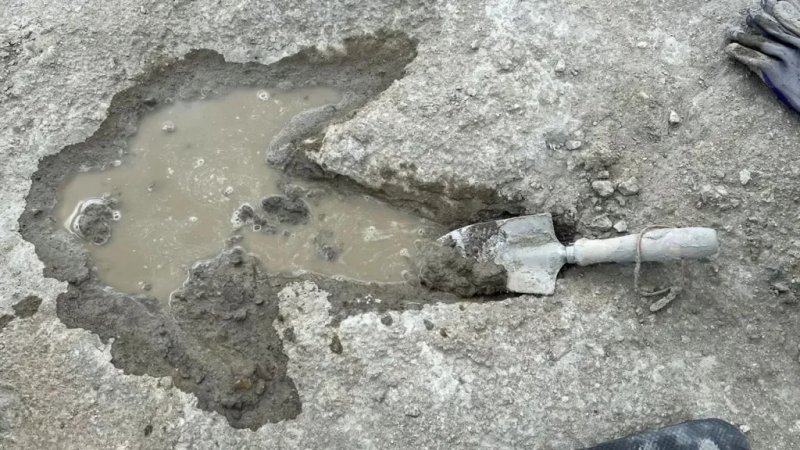
A trackway comprising 200 footprints dating back 166 million years has been identified as one of the longest of its kind ever uncovered, researchers have announced. The footprints were first spotted by a worker at Dewars Farm Quarry in Oxfordshire four years ago, prompting a team of paleontologists to investigate the site thoroughly. Since then, an excavation has revealed hundreds of footprints, believed to document the movements of Cetiosaurus, a massive sauropod dinosaur.

Dr Emma Nichols from Oxford University's Museum of Natural History was called in to co-lead the excavation and provided further insights into the discovery during an interview with BBC Radio Oxford. She explained that the four trackways of sauropod footprints varied significantly in size. This variation suggests several possibilities: the footprints could represent a family herd of Cetiosaurus moving together, or a herd comprising individuals of different ages, not necessarily related. Alternatively, the footprints might belong to more than one type of sauropod, News.Az reports, citing BBC.

Cetiosaurus were four-legged, long-necked, herbivorous creatures that could reach lengths of approximately 18 meters (59 feet). But they were not the only dinosaurs inhabiting what is now Oxfordshire. Nichols recalled that in 1997, during the first major excavation connected to recent work, a remarkable Megalosaurus trackway was discovered. She explained that during the prehistoric period, the land in Oxfordshire was dominated by Megalosaurus, which were about nine meters long and considered Britain's answer to T-Rex.

Looking back 166 million years, Nichols described the environment as a lush, tropical landscape. At that time, Britain was submerged under a shallow inland sea, with a series of islands resembling the Bahamas or Florida Keys. It was on these islands that the dinosaurs, including Megalosaurus and Cetiosaurus, lived. One particular area of the site even shows where a sauropod and Megalosaurus footprints crossed on the same bedding plane, indicating they shared the same environment and possibly interacted.

Most of the recently excavated footprints are evenly spaced, with one exception—an out-of-line print. Nichols suggested that this might indicate the sauropod paused and leaned on one leg, perhaps looking back over its shoulder. She emphasized that while we can only speculate about the animal's behavior, the positioning of the footprints might imply that Megalosaurus was tracking the herd from behind, as the predator would have been too large for the sauropod to hunt directly but could have been observing smaller animals within the group.

The future of the trackway remains uncertain, as scientists are collaborating with Smiths Bletchington, the quarry operators, and Natural England to explore options for preserving the site. They also believe that more footprints could still be hidden beneath the surface, waiting to shed further light on Earth's prehistoric past.


News.Az 

By Leyla Şirinova

Similar news

Archive

Prev Next
Su Mo Tu We Th Fr Sa
  1 2 3 4 5 6
7 8 9 10 11 12 13
14 15 16 17 18 19 20
21 22 23 24 25 26 27
28 29 30 31