Giant squid found in deep-sea canyon off Australia


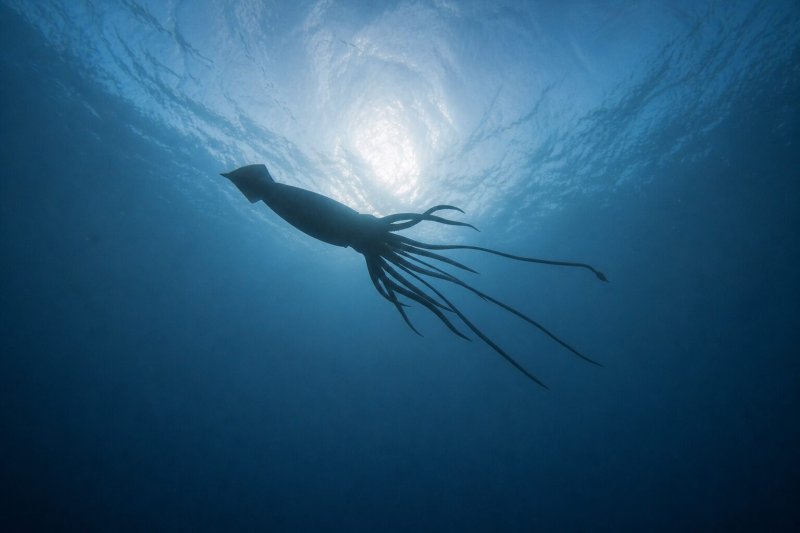
Deep-sea researchers exploring underwater canyons off the coast of Nyinggulu (Ningaloo) in Western Australia have identified hundreds of marine species, including several rare and elusive creatures, News.Az reports, citing BBC Wildlife Magazine.
Rather than relying solely on direct sightings, scientists detected the animals through water samples collected from the deep ocean.
Marine life continuously sheds tiny traces of DNA through skin, mucus and waste, allowing researchers to identify species by analyzing what is known as environmental DNA, or eDNA.
The research team surveyed the Cape Range and Cloates canyons, located about 1,200 kilometers north of Perth, to gain a better understanding of the region’s hidden biodiversity. Some samples were collected at depths reaching 4,510 meters.
RECOMMENDED STORIES
“These canyons are incredibly rich ecosystems and, until now, they’ve been largely unexplored because of the difficulty of working at such extreme depths,” said the study’s lead author, Georgia Nester. Nester is currently a researcher at the University of Western Australia and was previously a PhD candidate at Curtin University.
“With eDNA, a single water sample can tell us about hundreds of species at once. That means we can dramatically expand our understanding of deep-water environments in a way that simply hasn’t been possible before,” she added.
The environmental DNA analysis allowed scientists to build a clearer picture of life deep beneath the ocean surface, even without directly observing many of the animals. Among the most remarkable discoveries was evidence of a giant squid, a rarely seen deep-sea cephalopod that has not been recorded in Western Australian waters for more than 25 years.
“This is the first record of a giant squid detected off Western Australia’s coast using eDNA protocols and the northernmost record of the species A. dux in the eastern Indian Ocean,” said Dr. Lisa Kirkendale, head of aquatic zoology and curator of molluscs at the WA Museum.
Giant squid are known for their enormous tentacles, which can grow the animals to more than 13 meters in length, as well as their eyes, which can be as large as dinner plates. Despite their size, they are rarely encountered because they inhabit waters hundreds of meters below the surface.
“Finding evidence of a giant squid really captures people’s imagination, but it’s just one part of a much bigger picture,” Nester said.
Overall, the researchers identified evidence of 226 species living in the deep waters surrounding the canyons. These included pygmy sperm whales, which defend themselves by releasing a cloud of intestinal fluid similar to squid ink, as well as Cuvier’s beaked whales, considered the world’s deepest-diving mammals. Scientists also detected the unusually named bony-eared assfish.
Some of the species had never previously been recorded in Western Australian waters, including sleeper sharks, slender snaggletooths and faceless cusk eels. Researchers believe some of the findings may even represent species unknown to science.
“We found a large number of species that don’t neatly match anything currently recorded, which doesn’t automatically mean they’re new to science, but it strongly suggests there is a vast amount of deep-sea biodiversity we’re only just beginning to uncover,” Nester added.
Scientists say the findings are important for conservation efforts aimed at protecting fragile deep-sea ecosystems.
“Deep-sea ecosystems are vast, remote and expensive to study, yet they face growing pressure from climate change, fishing and resource extraction,” said senior author Zoe Richards, associate professor at Curtin University’s School of Molecular and Life Sciences.
“Environmental DNA gives us a scalable, non-invasive way to build baseline knowledge of what lives there, which is essential for informed management and conservation,” Richards said. “You can’t protect what you don’t know exists.”
By Nijat Babayev


Similar news