Hidden for centuries: lost mosaic reveals female hunter vs leopard


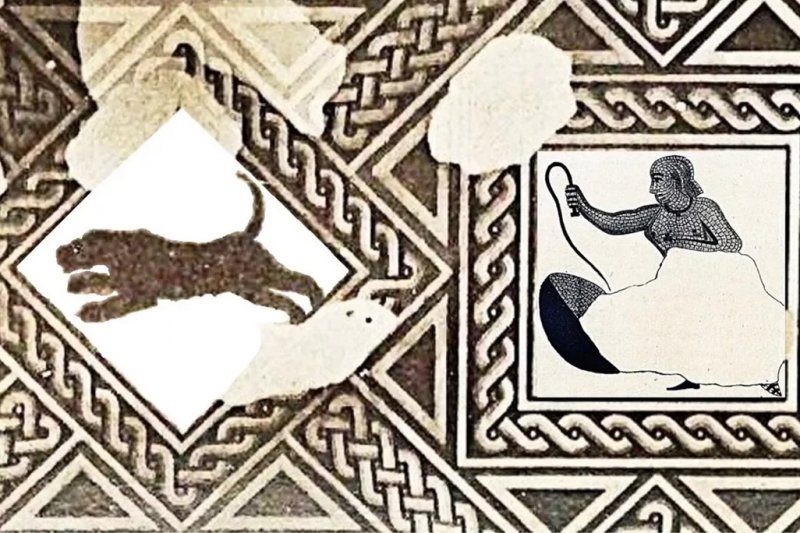
Destroyed in the chaos of WWI, a lost masterpiece may finally be 'seen' again. New research into historical sketches reveals what appears to be a female figure, whip in hand, facing down a leopard
A researcher may have identified a depiction of a female hunter—known as a venatrix—in an ancient Roman mosaic. According to a new study published in the International Journal of the History of Sport, the 1,800-year-old artifact provides rare visual evidence of women battling wild animals News.Az reports, citing smithsonianmag.com
“Women fighting beasts in arena games are attested by the written sources, but no visual source is known to show their image,” writes study author Alfonso Mañas, a sports historian at the University of California, Berkeley. As such, this mosaic may be “the first and only known image of a woman fighting beasts in the Roman arena.”
The mosaic was discovered in Reims, France, in 1860. The archaeologist Jean Charles Loriquet sketched a copy of the artwork, which dates to the third century C.E. Decades later, it was destroyed in a bombing during World War I, and only one fragment survived. But that fragment matches Loriquet’s drawing, suggesting that he may have copied the mosaic accurately. According to the drawing, the original mosaic featured 35 figures surrounded by intricate borders. These figures were a “mix of beasts, beast hunters and gladiators” from Roman arenas, writes Live Science’s Owen Jarus.
The woman is topless, and she holds the handle of a whip in her right hand. Her left hand holds the pommel of another weapon—“probably a dagger,” per the study, “which she would use to kill the beasts she fights.” She is looking straight ahead toward a leopard running in the opposite direction.
Previous research had identified the female figure “as an agitator, an inexistent arena role, or a paegniarius, a kind of clown with a whip,” according to the study. Instead, Mañas argues that she was a kind of venatrix known as a succursor. In this role, she may have wielded a whip to push the leopard toward another hunter.
Mosaics were a vibrant art form in ancient Rome. They often depicted battle scenes and mythological figures, and elites used them to decorate the floors of their homes. In 2020, for example, a mosaic featuring scenes from the Trojan War was discovered among the ruins of a Roman villa in England. The artwork shed new light on “the individual who commissioned this piece,” John Thomas, deputy director of the University of Leicester Archaeological Services, said in a 2021 statement. “This is someone with a knowledge of the classics, who had the money to commission a piece of such detail.”
The Reims mosaic was also excavated from the ruins of an ancient Roman home. Mañas tells Live Science that it probably belonged to a wealthy resident, who may have sponsored arena battles between humans and beasts. The mosaic was likely on the floor of the house’s dining hall, where “the guests of the host could admire [it],” he adds. Historians know that female gladiators fought in ancient Roman arenas during certain periods of history. According to the study, the emperors Nero and Titus oversaw such spectacles during the first century C.E. Several images of female gladiators survive, including one identified by Mañas in 2011.
Earlier this year, archaeologist Anna Miaczewska told PBS’ “Secrets of the Dead” about a Roman oil lamp depicting two gladiators with female features. “If we have one lamp like this, perhaps in the future we’re going to find more lamps with female gladiators on them,” she said.
Female gladiators were banned in 200 C.E., but the Reims mosaic suggests that women may have been allowed to continue fighting animals, Mañas tells Live Science. The ancient Romans saw women fighting beasts as less controversial than women fighting other humans, he adds. After all, the Roman goddess Diana was usually depicted as a hunter.
But some experts are skeptical of the Reims mosaic. We can’t know for sure whether Loriquet’s drawing is accurate, Thomas Scanlon, an emeritus classicist at the University of California, Riverside, tells Live Science. “The article is well documented, but my concern is that the actual mosaic is not extant,” Scanlon, who wasn’t involved in the study, says. “The images are from an old [drawing], which may not be reliable in detail.”
By Leyla Şirinova


Similar news