Azerbaijan–Serbia economic ties shift from niche trade to energy anchor


.png)
Editor's note: Faig Mahmudov is a journalist based in Azerbaijan. The views expressed in this article are his own and do not necessarily reflect those of News.Az.
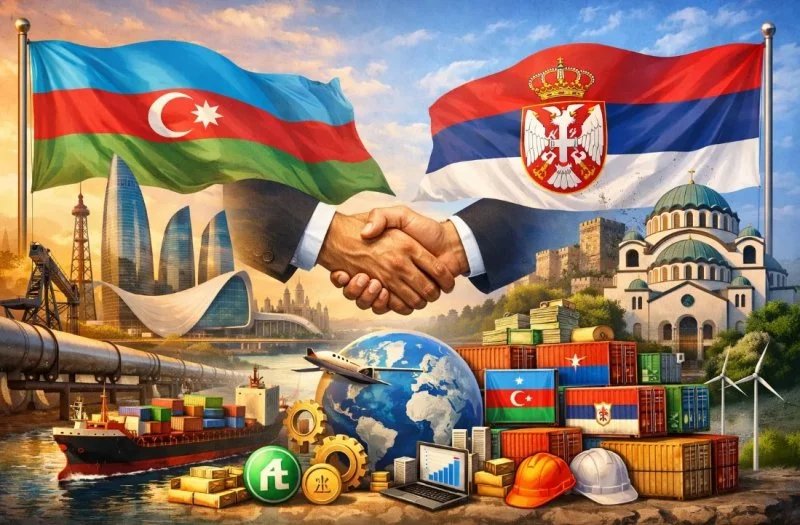
Over the past five years, Azerbaijan–Serbia economic relations have undergone a visible transformation. What began as a relatively small, import-heavy trade relationship has developed into a more strategic economic partnership, driven primarily by energy cooperation and large-scale commodity flows. While the absolute size of bilateral trade remains modest compared with Azerbaijan’s largest European partners, the structural shift that occurred after 2024 marks a clear turning point in the trajectory of relations between Baku and Belgrade.
RECOMMENDED STORIES
Between 2021 and 2023, economic ties were stable but limited in scale. Trade turnover during this period ranged from approximately $9 million to $11 million annually. In 2021, total trade stood at about $9.23 million, with Azerbaijan exporting goods worth roughly $1.19 million and importing about $8.04 million from Serbia. In 2022, turnover increased to around $10.89 million, with exports rising slightly to $1.74 million and imports reaching $9.14 million. In 2023, total trade edged up to $11.37 million, but Azerbaijan’s exports fell sharply to around $0.5 million, while imports climbed to nearly $10.87 million.
This pattern illustrates the structural imbalance of the early phase. Azerbaijan was largely a net importer from Serbia, while its exports remained sporadic and narrowly concentrated. Serbia supplied a range of consumer goods, processed foods, pharmaceuticals, and industrial products that fit naturally into Azerbaijan’s import demand. By contrast, Azerbaijan’s non-oil export basket was not well aligned with Serbian import needs, and logistical routes between the two countries were not optimized for regular, high-volume trade. As a result, trade remained small and largely dependent on ad hoc transactions rather than long-term commercial programs.
This pattern illustrates the structural imbalance of the early phase. Azerbaijan was largely a net importer from Serbia, while its exports remained sporadic and narrowly concentrated. Serbia supplied a range of consumer goods, processed foods, pharmaceuticals, and industrial products that fit naturally into Azerbaijan’s import demand. By contrast, Azerbaijan’s non-oil export basket was not well aligned with Serbian import needs, and logistical routes between the two countries were not optimized for regular, high-volume trade. As a result, trade remained small and largely dependent on ad hoc transactions rather than long-term commercial programs.

Source: APA
The decisive shift occurred in 2024. That year marked a dramatic expansion in reported trade figures, with total trade reaching around $190 million. Azerbaijan’s exports to Serbia were reported at approximately $181.25 million, a multiple of all previous years combined. A major driver of this surge was crude oil exports. In the first nine months of 2024 alone, Azerbaijan exported more than 241,000 tons of crude oil to Serbia, with a total value of about $151.9 million. These energy shipments fundamentally altered the scale and visibility of bilateral economic relations.
In parallel, gas cooperation moved from political declarations to operational reality. The two countries implemented agreements allowing Serbia to import up to 400 million cubic meters of Azerbaijani gas by the end of 2024. These supplies strengthened Serbia’s energy security at a time of broader volatility in European gas markets and positioned Azerbaijan as a reliable partner in the Balkans. Even when gas deliveries are not fully reflected in traditional merchandise trade statistics, their economic and political impact is substantial, as they involve long-term contracts, infrastructure coordination, and strategic planning.
The year 2025 saw a partial pullback in headline trade figures, with reported turnover declining to around $135 million. However, this decline should not be interpreted as a reversal of the broader trend. Rather, it reflects normalization after an exceptional spike in 2024 driven by large commodity flows. Commodity timing, pricing fluctuations, and base effects all contribute to such volatility. Importantly, Azerbaijan’s imports from Serbia reportedly increased by about 55 percent year on year in 2025, suggesting that baseline trade in non-energy goods was actually strengthening.
Investment remains the weakest and most underdeveloped pillar of bilateral economic relations. Serbian investments in Azerbaijan’s non-oil sector are estimated at around $10 million, symbolically important but economically limited. At the same time, official statements increasingly emphasize Azerbaijan’s interest in investing in Serbia, particularly in infrastructure and energy-related projects. Without a significant expansion in two-way investment, the relationship risks remaining overly dependent on energy trade and vulnerable to commodity cycles.
For the partnership to gain long-term resilience, investment-driven cooperation is essential. Energy infrastructure projects, including gas storage and downstream distribution, could deepen interdependence. Transport and logistics initiatives could position Serbia as a Balkan hub for Azerbaijan-linked trade flows. Agribusiness and food processing offer opportunities for joint ventures that combine Serbian production capacity with Azerbaijani capital and market access. In addition, cooperation in ICT and services could diversify economic ties beyond physical trade and commodities.

Source: Trend
(If you possess specialized knowledge and wish to contribute, please reach out to us at opinions@news.az).


Similar news