Cantürk Caner: "Ankara is telling Moscow: the Black Sea is not Russia’s internal lake" - INTERVIEW


TTurkish Foreign Minister Hakan Fidan’s upcoming visit to Moscow on 15–17 June comes at a time when several major geopolitical crises are converging. The war in Ukraine, tensions in the Black Sea, shifting dynamics in the South Caucasus, developments in Syria and energy security concerns have elevated the significance of the trip well beyond that of a routine diplomatic engagement.
- Mr Caner, how do you assess Hakan Fidan’s upcoming visit to Moscow?
- I would describe this visit as a multi-layered diplomatic move. It cannot be reduced to the formula: “Fidan will meet Lavrov and the two sides will discuss bilateral relations.” That interpretation is far too narrow for the current situation.
RECOMMENDED STORIES
Today, Türkiye is operating in an extremely complex international environment. On the one hand, it remains part of the Western security system. On the other, it maintains dense channels of communication with Russia. At the same time, Ankara seeks to act as an independent centre of decision-making, rather than a country that automatically aligns itself with someone else’s line.
Fidan’s visit to Moscow should be read precisely through this logic: Türkiye wants to remain at the table on all tracks where Russia has influence — from the Black Sea and Ukraine to Syria, the South Caucasus, energy, and transport corridors. In great power politics, those who are absent from the table very quickly risk finding themselves on the menu. Human history, for some reason, keeps repeating this lesson at a very high cost.
- Why is this visit taking on particular importance now?
- The timing is highly revealing. The world is witnessing the overlap of several crises at once: the war in Ukraine, tensions in the Black Sea, instability in the Middle East, a new configuration in the South Caucasus, energy security issues, sanctions pressure, and the struggle over transit routes.
Officially, this is described as a working visit, including talks with Lavrov and other bilateral contacts. But the wording about additional meetings is important. It suggests that the trip may cover a much wider range of issues — security, energy, regional crises, economic ties, and possibly coordination on certain tracks.
The Russian-Turkish agenda has long gone beyond the classic triangle of “trade, tourism and energy.” Today, it is already a conversation about regional architecture. Moscow and Ankara often compete, sometimes diverge, and occasionally clash sharply, yet they continue to talk. That is the defining feature of their relationship: conflict does not break communication channels.
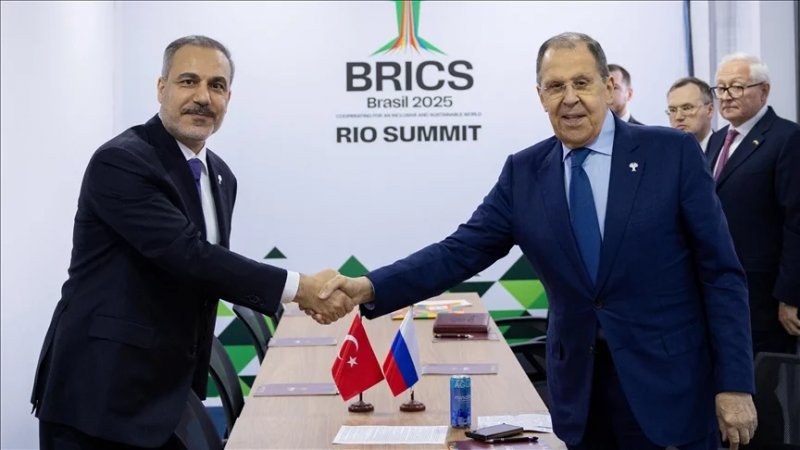 Source: Anadolu Agency
- What place will the war in Ukraine occupy in these talks?
- Ukraine will be one of the central issues. Türkiye follows a dual but deliberate line: it supports Ukraine’s territorial integrity while not cutting off channels with Russia. In the West, this position is sometimes described as a “grey zone.” For Ankara, it is not a grey zone but a space for diplomatic manoeuvre.
Türkiye does not want to speak to Moscow in the language of final rupture. It believes that even during war, windows must remain open for negotiations, exchanges, grain initiatives, humanitarian arrangements, and discussions on a future ceasefire. Ankara therefore seeks to preserve its role as a platform that may be needed by both sides.
Fidan’s visit to Moscow effectively renews the signal: “The Istanbul channel remains open.” Even if direct negotiations are stalled and Moscow and Kyiv remain far from compromise, Türkiye wants to retain its status as a country capable of reconnecting broken lines of communication.
- Can we say that, for Türkiye, the war in Ukraine is also a Black Sea issue?
- Absolutely. For Ankara, Ukraine is a question of the Black Sea balance of power, energy, maritime security, grain routes, NATO-Russia dynamics, and the regime of the straits. The Black Sea is a strategic buffer for Türkiye. Ankara is not interested in seeing Russia turn it into a space of uncontested dominance. But at the same time, Türkiye does not want the Black Sea to become an excessively militarised zone of direct NATO-Russia confrontation.
That is why Türkiye’s line is one of controlled equilibrium, containment of extremes, and preservation of its own role as a guarantor of balance. To the West, Ankara says: “We are allies, but we are not an automatic frontline state.”
To Russia, it sends another message: “We are ready for dialogue, but we do not recognise the Black Sea as a zone of exclusive control by any single power.”
- How important is the South Caucasus on the Fidan–Lavrov agenda?
- The South Caucasus may be one of the most sensitive tracks in these talks. After 2020, the region changed fundamentally. After 2023, the previous Karabakh configuration effectively ceased to exist. Azerbaijan strengthened its position, Armenia began seeking Western channels more actively, and Russian influence in the region no longer appears as monolithic as before.
For Türkiye, this space has direct strategic significance. It concerns Azerbaijan, the Zangezur corridor, transport routes, links with the Turkic world, energy, security, and access to Central Asia.
Ankara is not seeking to fully push Russia out of the South Caucasus. That would be too blunt and risky. Türkiye’s objective is different: to limit Russia’s monopoly, strengthen the Azerbaijani-Turkish strategic link, promote regional connectivity, and ensure that the future of the Caucasus is not decided without Türkiye and Azerbaijan.
- How does Syria fit into this picture?
- Syria remains one of the issues where it is difficult for Ankara to build a long-term strategy without engaging with Moscow. Yes, Russia’s military and diplomatic presence in Syria is no longer as strong as in previous years. But Russian influence on the Syrian track has not disappeared entirely.
For Türkiye, the Syrian issue is linked to multiple risks at once: the PKK/YPG, refugees, border security, the future of Damascus, Iranian influence, Israeli strikes on Syria and Lebanon, and the risk of broader regional escalation.
President Erdoğan’s recent statements that Israel’s actions in Syria and Lebanon also pose a threat to Türkiye show that Ankara now views its southern policy in broader terms than counterterrorism alone. This is a space where Israel, Iran, Russia, the United States, Arab states, and Türkiye intersect.
Therefore, Fidan’s visit to Moscow is also an attempt to compare positions on Syria and the wider Middle East. Türkiye wants to assess where Russia still has leverage, where it is retreating, where it is bargaining, and where it could become a situational partner.
- Does energy remain the foundation of Russian-Turkish relations?
- Yes, energy remains the strategic backbone of the relationship. TurkStream, Blue Stream, Akkuyu, gas, oil, payment mechanisms and logistics all create a dense network of interdependence.
But there is an important nuance: Ankara does not want to remain a passive consumer of Russian energy. Türkiye’s goal is to become an energy hub, a transit centre, and a platform for redistribution and negotiation. This is no longer simple energy trade; it is geoeconomics.
For Türkiye, this approach creates opportunities: strengthening its role as an energy hub, increasing its bargaining power, and leveraging tensions between Russia and the West. But the risks are also significant: secondary sanctions, pressure from Western partners, dependence on Russian infrastructure, and vulnerability in supply chains.
That is why the energy track in Moscow will also have a political dimension. It is not just about pipelines or tariffs, but about Türkiye’s strategic autonomy.
- What signal does this visit send to the West?
- Ankara is sending a very clear message to the West: Türkiye remains part of the Western security system, but it does not accept the role of a peripheral state that automatically follows every Western decision.
This is a matter of principle. Türkiye wants to be a NATO member with its own voice. It wants to negotiate with the European Union from a position of strength, not dependency. It supports Ukraine but maintains contacts with Moscow. It participates in Western formats but does not want to become an instrument of someone else’s strategy in the Middle East or the Black Sea.
For Washington and European capitals, this may be uncomfortable. But this is precisely what Turkish diplomacy has become: alliance without subordination, partnership without automatic alignment, and independence without demonstrative rupture.
 Source: Anadolu Agency
- And what signal does Moscow receive?
- Russia receives an equally clear message: Türkiye is important, but it is not prepared to make unlimited concessions.
Ankara is effectively telling Moscow: we will continue dialogue on the Black Sea, but we do not recognise it as your internal lake. We are ready to discuss Syria, but the PKK/YPG issue remains a red line. We will not ignore Russia in the South Caucasus, but we will not allow the Azerbaijani-Turkish strategic link to be blocked. We are ready to cooperate on energy, but Türkiye will not become merely a transit terminal for Russian gas. We can facilitate talks on Ukraine, but our position on Crimea and Ukraine’s territorial integrity remains clear and principled.
This is a more assertive version of Türkiye’s balancing policy. It is not Eurasian in ideological terms. Rather, Türkiye uses the Eurasian space to reinforce its own strategic autonomy.
- In that case, how can Ankara’s main objective be formulated?
- The main objective is to remain indispensable. Türkiye wants to be a country without which it is difficult to discuss the Black Sea, Ukraine, Syria, the South Caucasus, energy routes, migration, security and transit.
This is a highly ambitious strategy. It gives Türkiye room for manoeuvre, but also creates significant pressure. The more fronts Ankara engages on, the greater the risk of its interests clashing with different centres of power.
The West will be irritated. Russia will negotiate. Iran will watch closely. Israel will interpret Turkish signals through the prism of Syria and regional security. Azerbaijan will expect strategic clarity in the Caucasus. Ukraine will closely monitor whether Türkiye’s dialogue with Moscow leads to concessions.
That is the price of high-level diplomacy: when everyone is slightly dissatisfied, but no one can afford to ignore you.


Similar news