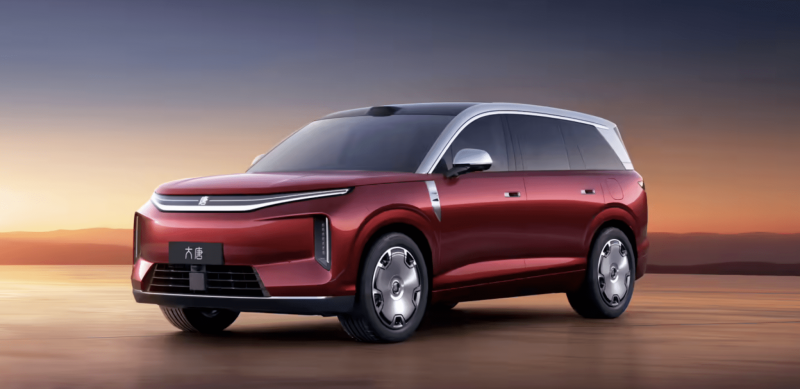
The new model is expected to build on the success of BYD’s Tang lineup, which has already established itself as one of the company’s flagship SUV series. The introduction of the Great Tang signals not only a product upgrade but also a broader push to strengthen BYD’s dominance in its home market while reinforcing its global ambitions.
At a time when competition in the electric vehicle sector is intensifying, particularly with rivals such as Tesla, the launch reflects BYD’s strategy of continuous innovation, rapid model rollout, and strong positioning in the mid to premium SUV segment.
What makes the Great Tang different
While full technical specifications are still emerging, early indications suggest that the Great Tang SUV will feature upgrades in design, performance, and digital integration.
The vehicle is expected to adopt BYD’s latest design language, combining a more refined exterior with a technologically advanced interior. Industry observers anticipate improvements in battery efficiency, driving range, and smart cockpit features, including enhanced infotainment systems and driver assistance capabilities.
BYD’s proprietary battery technology, particularly its Blade Battery, is likely to remain central to the model. This technology is known for its safety, durability, and cost efficiency, giving BYD a competitive edge in a market where battery performance is a key differentiator.
How the launch fits into BYD’s broader strategy
The introduction of the Great Tang aligns with BYD’s broader approach of scaling its product portfolio while maintaining competitive pricing and strong domestic penetration.
China remains the world’s largest electric vehicle market, and BYD has consistently leveraged its home advantage to drive volume growth. By expanding its SUV offerings, the company is targeting one of the fastest growing segments in the automotive industry.
SUVs account for a significant share of consumer demand in China, particularly among families and urban professionals. The Great Tang is positioned to capture this demand by offering a combination of performance, space, and advanced technology.
At the same time, BYD continues to expand internationally, entering markets across Europe, Southeast Asia, and Latin America. While the Great Tang is initially focused on China, it could later be adapted for global markets, depending on demand and regulatory requirements.
How BYD is competing with global rivals
BYD’s rise has reshaped the competitive landscape of the electric vehicle industry. The company has rapidly increased its production capacity, diversified its model lineup, and strengthened its supply chain through vertical integration.
Unlike many competitors, BYD manufactures key components in house, including batteries, semiconductors, and electric drivetrains. This approach allows for greater cost control and faster innovation cycles.
The launch of the Great Tang comes as competition intensifies not only with Tesla but also with traditional automakers transitioning to electric mobility. Companies across the United States, Europe, and Asia are investing heavily in new EV models, making the market more crowded and dynamic.
BYD’s ability to introduce new models quickly and at scale gives it a distinct advantage, particularly in price sensitive segments.
Why SUVs are central to EV growth
The focus on SUVs is not accidental. Globally, SUVs have become the dominant vehicle category, and this trend is mirrored in the electric vehicle sector.
Consumers are increasingly drawn to SUVs for their higher driving position, larger interior space, and perceived safety. Electric SUVs combine these advantages with the benefits of zero emission driving, making them particularly attractive in urban environments.
By launching the Great Tang, BYD is reinforcing its presence in this high demand segment, ensuring that it remains competitive as consumer preferences evolve.
What this means for the Chinese EV market
The arrival of the Great Tang is likely to intensify competition within China’s already crowded EV market. Domestic manufacturers are engaged in a rapid cycle of innovation, frequently launching new models with upgraded features and competitive pricing.
This environment benefits consumers, who gain access to a wide range of options, but it also puts pressure on manufacturers to differentiate themselves.
BYD’s strong brand recognition and technological capabilities position it well to navigate this landscape. However, maintaining leadership will require continuous innovation and responsiveness to market trends.
What to expect from the May launch
The official launch in May is expected to reveal detailed specifications, pricing, and availability. Industry analysts will be watching closely to see how the Great Tang is positioned relative to competing models.
Key factors that will determine its success include pricing strategy, range performance, charging capabilities, and the integration of smart technologies.
If the model meets expectations, it could further strengthen BYD’s position as a leading force in the global electric vehicle industry.
Conclusion
The upcoming launch of the Great Tang SUV represents more than just a new product release. It reflects BYD’s broader ambition to dominate the electric vehicle market through innovation, scale, and strategic positioning.
As competition intensifies and the EV market continues to evolve, the success of models like the Great Tang will play a crucial role in shaping the future of mobility, both in China and beyond.