Japan eyes extra budget as oil prices strain economy


Japanese Prime Minister Sanae Takaichi said on Monday that her government will consider compiling an extra budget for fiscal 2026 to ease the impact of elevated crude oil prices, raising renewed concerns about Japan’s worsening public finances as long-term bond yields approach nearly 30-year highs, News.Az reports, citing Kyodo.
The size of the supplementary budget has drawn scrutiny following the enactment of a record 122.31 trillion yen ($770 billion) budget for the fiscal year beginning in April.
The budget highlights Japan’s heavy reliance on debt financing and reflects Takaichi’s approach of expansionary spending aimed at stimulating economic growth.
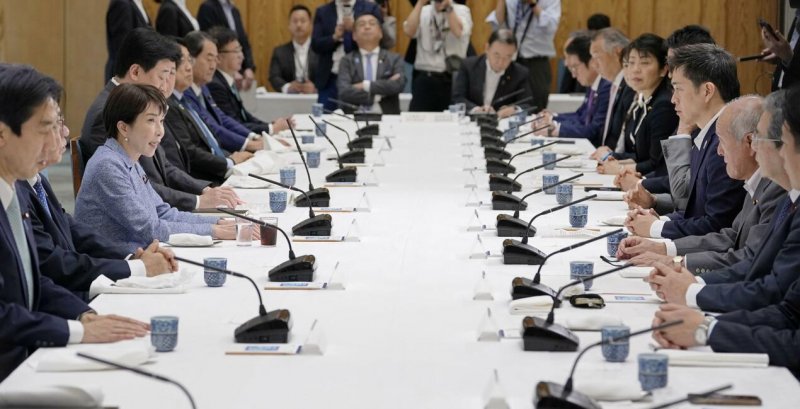
“We will make decisions appropriately and respond in a timely manner as needed so that economic activities and people’s lives are not disrupted” due to the situation in the Middle East, Takaichi said during a liaison meeting with government officials and ruling party representatives at her office.
RECOMMENDED STORIES
She instructed Finance Minister Satsuki Katayama to examine the possibility of preparing a supplementary budget, as gasoline subsidies are expected to continue and financial support for households covering gas and utility bills is planned for the summer.
With crude oil prices rising, the government has already allocated more than 1 trillion yen for gasoline price subsidies that were restarted in mid-March, including reserve funds in the fiscal 2025 budget. However, this amount had fallen to around 980 billion yen by the end of April.
Each month, hundreds of billions of yen are expected to be spent to keep fuel prices at around 170 yen per liter. Some economists estimate that the available funds could be exhausted by the end of June.
Takaichi also said she instructed policy chiefs from the ruling Liberal Democratic Party and its coalition partner Japan Innovation Party to develop detailed support measures for electricity and gas bills for households during the July–September period, when demand for air conditioning is highest.
She stressed that any measures should ensure utility bills remain below levels seen in the same period last year.
Typically, Japan compiles supplementary budgets later in the fiscal year, often in the autumn or beyond.
Takaichi’s proposal comes despite her repeated statements that she aims to move away from the practice of relying on supplementary budgets every year, arguing instead that necessary expenditures should be included in the initial budget.
The early consideration of an extra budget also comes as yields on the benchmark 10-year Japanese government bond have been trending upward amid persistent concerns about fiscal sustainability under the Takaichi administration.
On Monday, the yield on the benchmark 10-year Japanese government bond briefly rose to 2.800 percent, its highest level since May 1997, as selling pressure increased over concerns about public finances.
Rising borrowing costs could increase debt-servicing expenses for Japan, whose debt is estimated at 204.4 percent of gross domestic product—the highest ratio among Group of Seven nations, according to the International Monetary Fund.
Utility bill subsidies have been used intermittently since Russia’s full-scale invasion of Ukraine in 2022, which contributed to higher global energy prices.
However, these subsidies are costly. Between January and March, the government spent 529.6 billion yen from a supplementary budget for fiscal 2025 to reduce household energy bills by about 7,000 yen.
While the government could draw on reserve funds totaling 1 trillion yen in the fiscal 2026 budget for economic measures, some analysts warn this may not be sufficient, and critics argue such reserves should instead be preserved for emergencies such as natural disasters.
By Nijat Babayev


Similar news