.png)

In January 2026, Russia carried out one of the heaviest and most coordinated winter attacks against Ukraine. The large-scale nighttime missile and drone assault targeted several regions of the country, particularly the capital, Kyiv, and western areas in the direction of Lviv.
As part of the attack, Russia reportedly used a new type of ballistic missile known as Oreshnik under combat conditions. The strike drew attention not only for its military impact but also for its civilian and humanitarian consequences.
According to preliminary information, more than 230 unmanned aerial vehicles and over 30 missiles of various types were launched at Ukrainian territory during the night of the attack. Air defense systems managed to neutralize approximately 70 percent of the incoming weapons, but the remainder reached their targets. The wave of attacks lasted around six hours, with explosions recorded in central, western, and northern regions. Energy and industrial infrastructure were among the primary targets.

Source: KyivPost
As a result of the attack, six civilians were killed and more than 40 people sustained injuries of varying severity. Most of the wounded were hospitalized with injuries caused by collapsing buildings, shrapnel, and burns. Women and children were among the injured. Emergency medical services operated under an emergency regime, responding to hundreds of calls within a 24-hour period.
Kyiv was among the cities most severely affected. Strikes on electrical substations and heating lines left more than 500,000 households without power, while approximately one million residents faced serious disruptions to heating supplies. More than 120 residential buildings across the city were damaged, and the infrastructure of 15 schools and eight medical facilities was partially disabled. The transportation system was also heavily affected: sections of the metro were temporarily closed, and around 30 percent of electric public transport ceased operations. Authorities were forced to establish emergency heating centers and generator points.

Source: Reuters
In the Lviv direction, where the Oreshnik was reportedly used, the consequences of the strike were primarily structural and technical. An attack on a state-owned industrial facility in the region severely damaged one production complex and rendered three auxiliary buildings unusable. The blast wave created numerous craters within a radius of approximately two kilometers.
Although no casualties were reported, production was completely halted, leaving hundreds of workers temporarily without jobs. Preliminary assessments estimate the material damage at tens of millions of dollars.
Several buildings housing diplomatic missions in Kyiv were also damaged during the attack. Glass facades were shattered and internal communication systems were disrupted. Although no injuries were reported, the incident caused serious international concern and further underscored the regional security risks posed by the strike.

Source: CNN
Overall, more than 200 civilian facilities across the country were damaged, and approximately 50,000 people were forced to temporarily leave their homes for security reasons. As a result of strikes on electricity, heating, and water supply systems, up to three million people experienced intermittent disruptions to basic services. Humanitarian needs increased sharply, while the state budget came under additional pressure due to reconstruction and repair costs.
The January attack is regarded as a significant episode indicating that the war in Ukraine has entered a new phase. Targeting energy infrastructure during winter demonstrated the continuation of a “weaponization of winter” strategy. At the same time, the use of the Oreshnik missile showed that the attack carried not only a military purpose but also a psychological and strategic message. The fact that strikes were recorded in areas close to NATO borders further intensified regional security concerns and increased the risk of potential escalation.
Russia’s previous Oreshnik attacks on Ukraine
Source: TASS
Before 2026, Russia used the Oreshnik missile system against Ukraine at least twice. These attacks did not constitute a large-scale campaign and were primarily intended for testing, demonstration, and psychological effect.
The first Oreshnik strike was recorded toward the end of 2024. The attack targeted central Ukraine, mainly rear-area districts around Kyiv. As a result, several technical and auxiliary infrastructure facilities were damaged, and temporary disruptions occurred to energy and communications lines. No casualties were reported, and material damage remained limited in scale.
The second attack took place in the fall of 2025 in western Ukraine, primarily in areas close to the Lviv region. Industrial and logistics-related facilities were selected as targets. As a result, operations at one industrial facility were halted, and structural damage and craters appeared in surrounding areas. No loss of life was reported, but noticeable economic and production-related damage was recorded.
U.S. reaction to Russia’s Oreshnik strike on Ukraine

Source: CNN
The use of the Oreshnik missile system by Russia against Ukraine was met with serious concern in official circles in the United States. Washington described the attack as a technological and psychological escalation of the war and emphasized that Russia was testing new types of weapons under combat conditions. According to U.S. officials, such strikes expand both the geographic scope and the level of risk of the conflict, particularly by setting a dangerous precedent in targeting rear-area and civilian infrastructure.
U.S. defense authorities stated that they were analyzing the technical characteristics and real combat impact of the Oreshnik. According to assessments, the weapon does not fundamentally alter the balance on the battlefield, but its high speed and difficulty of interception create additional risks for air defense systems. The U.S. side believes that Russia is using this weapon primarily as a political signal and a tool of psychological pressure.
In the U.S. Congress, the attack intensified debates over increasing support for Ukraine. Several lawmakers cited it as further evidence of the need to provide Ukraine with additional air defense systems and missile defense capabilities.
President Donald Trump did not issue a separate, detailed official statement on the matter. However, in recent speeches and interviews, he emphasized that escalation in the Ukraine war is dangerous and that the use of new types of weapons could push the conflict into a more uncontrollable phase. Trump has generally stated that he opposes prolonging the war and that U.S. interests lie not in escalation but in achieving a rapid political settlement.
At the same time, he described Russia’s use of new and heavy weapons as a “dangerous signal” and said such actions undermine international security.
Overall, the U.S. position is that the use of the Oreshnik does not change the fundamental nature of the war but does increase the risks of escalation. Trump’s statements, while differing from the official line, focus primarily on calls to end the war and pursue a political agreement, yet he has also clearly described Russia’s deployment of new weapons as a dangerous development.
The Oreshnik missile system: technical characteristics, combat capabilities, and lethality potential
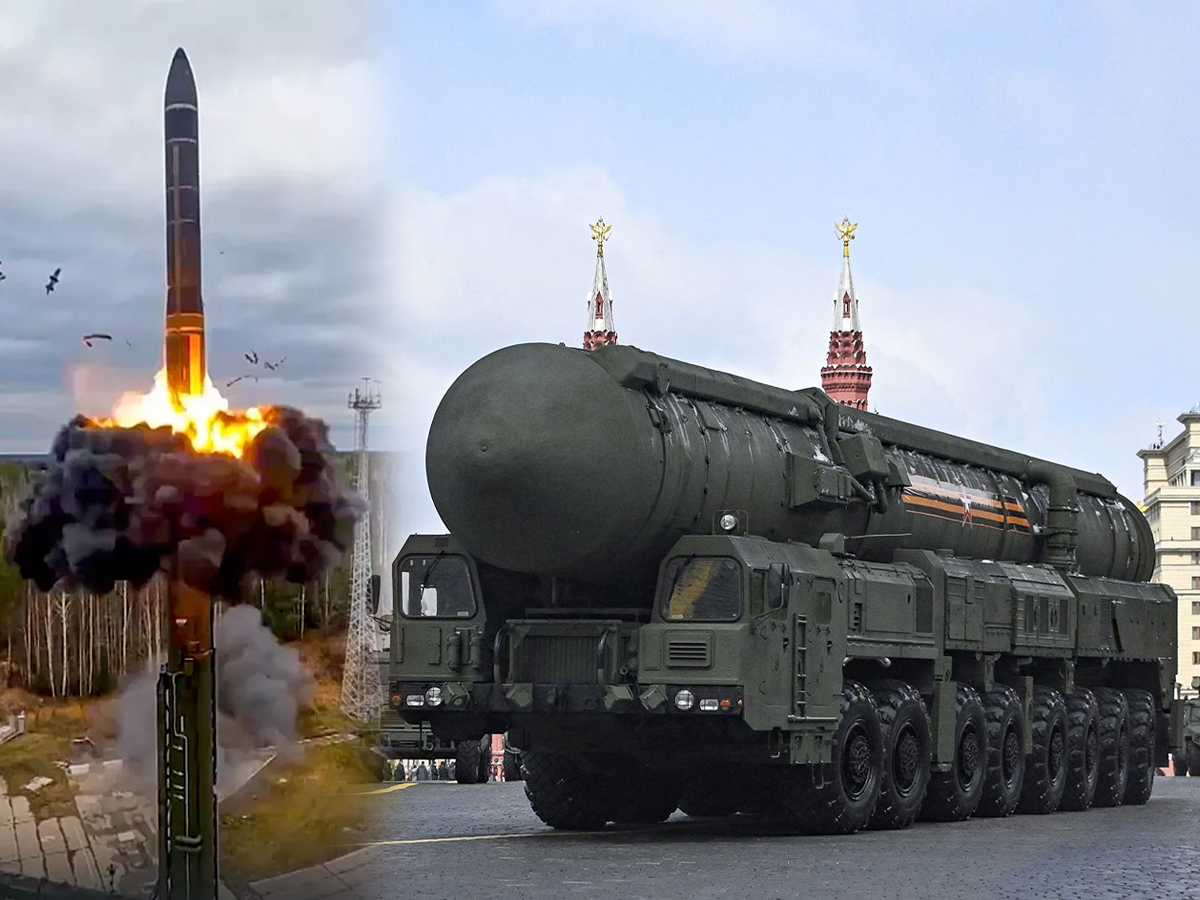
Source: sundayguardianlive
The Oreshnik is a missile system presented as part of Russia’s new generation ballistic missile programs and is generally assessed as an operational-tactical and medium-range strike weapon. Its primary purpose is to strike critical infrastructure, industrial zones, energy facilities, and logistics hubs located far from the front line with high speed and precision. Rather than a conventional mass bombardment weapon, the Oreshnik is viewed as an instrument of strategic pressure and escalation.
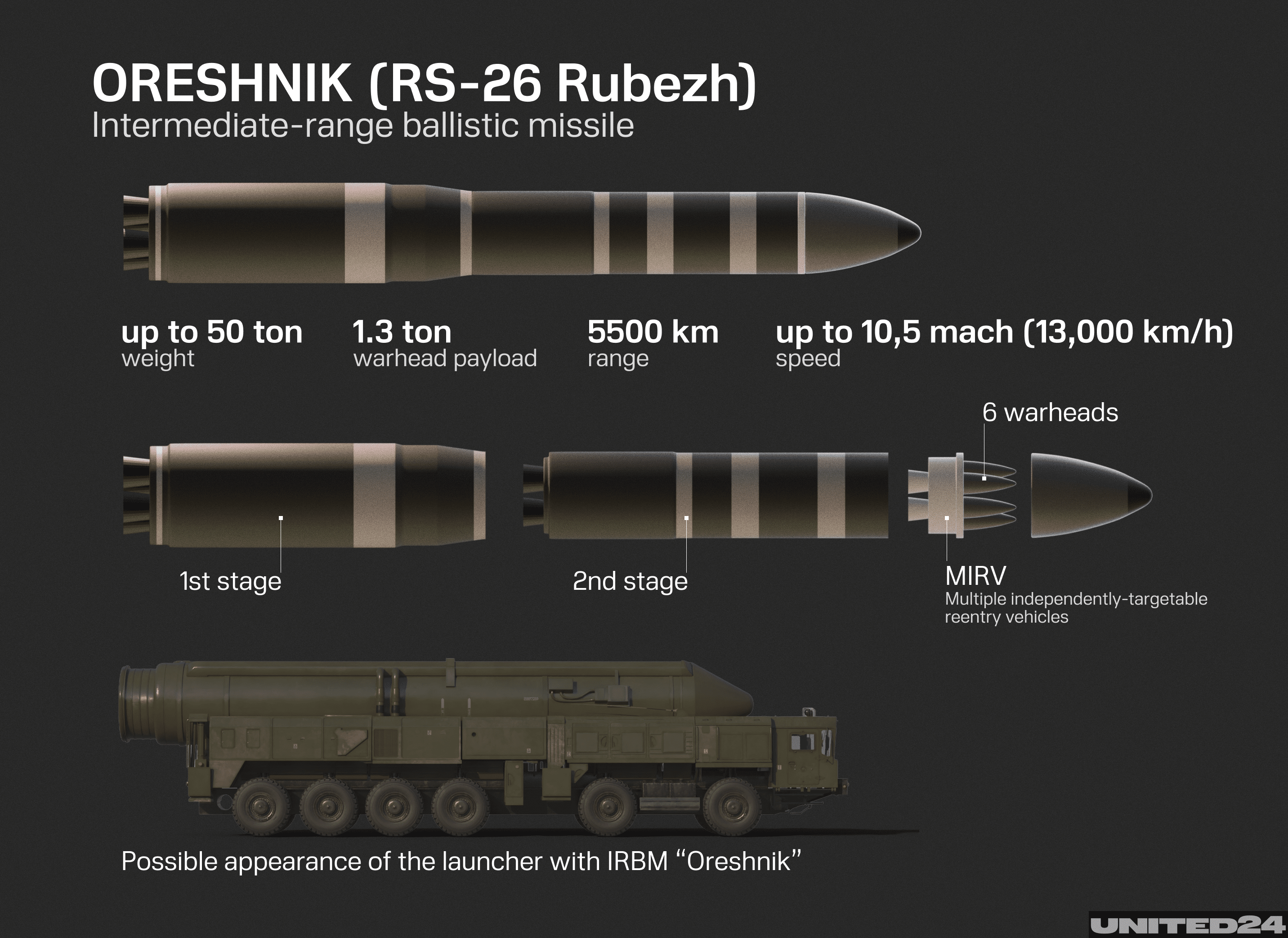
Open source and analytical assessments outline the following technical profile:
Source: TASS
– Missile type: solid-fuel ballistic missile;
– Range: 1,500–2,500 km;
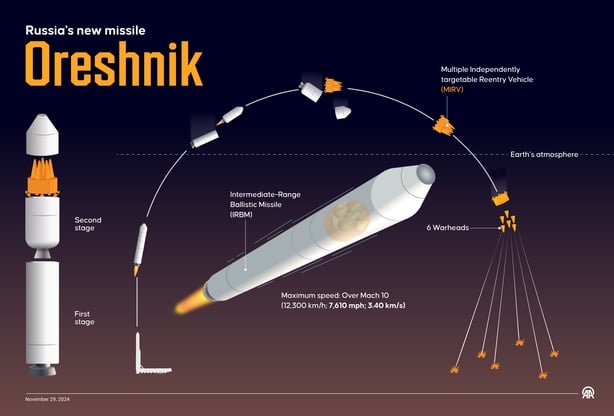
– Maximum speed: Mach 8–10 (approximately 9,800–12,300 km/h);
– Flight altitude: 100–300 km (ballistic phase);
– Launch platform: mobile ground-based launchers;
– Reaction and preparation time: 5–15 minutes;
– Warhead weight: 300–500 kg;
– Warhead types: high-explosive, cluster-type, inert (training or demonstration);
– Accuracy (CEP): 10–30 m;
– Impact angle: steep, almost vertical.
These characteristics make the Oreshnik a difficult target for existing air defense systems. Its high speed and steep terminal descent significantly reduce the probability of interception. At speeds above Mach 8, reaction times are measured in seconds.
In terms of lethality, the Oreshnik delivers extremely destructive effects at the point of impact. With a high-explosive warhead:
– severe structural destruction occurs within a 200 m radius;
– serious damage and secondary explosions are possible within a 300–400 m radius;
– dangerous shrapnel and blast-wave effects may extend up to 500 m.
Source: TASS
When equipped with a cluster warhead, the destructive effect spreads over a wider area, increasing risks to equipment, open infrastructure, and industrial sites. Nevertheless, reported uses to date indicate that the Oreshnik has been employed mainly with conventional non-nuclear or inert warheads.
Strategically, the power of the Oreshnik is not limited to physical destruction. The ability to launch from distances exceeding 1,500 km, combined with high speed and 10–30 m accuracy, turns the missile into both a psychological instrument and a political-military signaling tool. For this reason, the Oreshnik is often assessed less as a response to immediate battlefield needs and more as a signal of escalation and a demonstration of technological capability.
In conclusion, the Oreshnik missile system possesses higher speed, longer range, and more difficult interception characteristics than classic operational-tactical missiles. While its lethality potential is high, its primary role is not mass civilian casualties but the disabling of critical infrastructure and the exertion of strategic pressure.