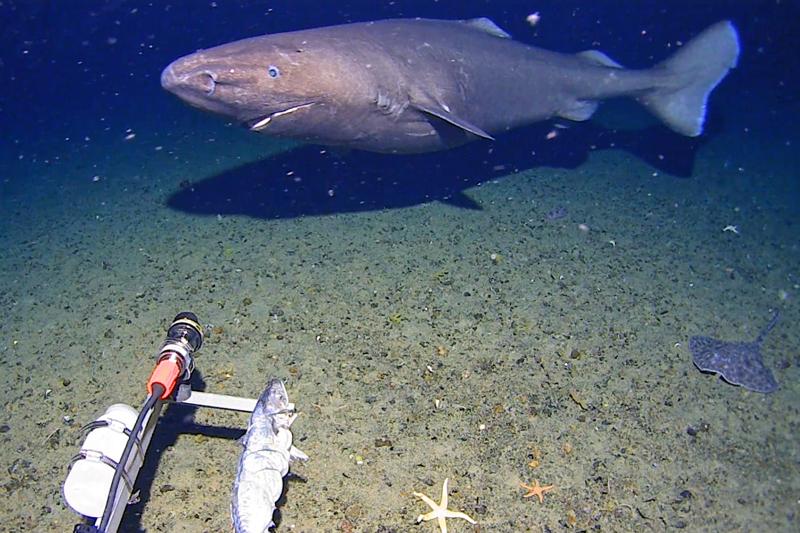
The shark, recorded in January 2025 at a depth of 490 meters (1,608 feet), measured an estimated 3 to 4 meters (10 to 13 feet) in length, News.Az reports, citing Kyodo.
The footage was captured by a camera operated by the Minderoo-UWA Deep-Sea Research Centre off the South Shetland Islands near the Antarctic Peninsula — well within the Southern Ocean, defined as waters south of 60 degrees latitude.
Researcher Alan Jamieson said the team had not expected to encounter sharks in Antarctica. “There’s a general rule of thumb that you don’t get sharks in Antarctica,” he noted, describing the animal as a substantial specimen. “It’s a hunk of a shark. These things are tanks.”
The water temperature at the filming site was just 1.27 degrees Celsius (34.29 degrees Fahrenheit). The shark cruised slowly above a barren seabed, passing a skate — a close relative of sharks resembling a stingray — that remained motionless and undisturbed.
Jamieson, founding director of the University of Western Australia-based research center, said he found no prior record of a shark documented so far south in the Antarctic Ocean. Conservation biologist Peter Kyne of Charles Darwin University, who was not involved in the research, also said such a sighting had not been previously recorded.
Scientists say climate change and warming oceans could potentially influence shifts in shark distribution, though limited data from the remote Antarctic region makes it difficult to determine range changes. Kyne suggested sleeper sharks may have long existed in Antarctic waters without being detected.
Jamieson believes the shark was maintaining a depth of around 500 meters because that layer represented the warmest band of water in a stratified ocean system. The Antarctic Ocean is layered to depths of about 1,000 meters due to dense, colder water below and fresher meltwater above, which do not easily mix.
He expects other sleeper sharks could inhabit similar depths, feeding on carcasses of whales, giant squid and other marine life that sink to the ocean floor.
Few research cameras operate at such depths in Antarctic waters, and those that do function only during the Southern Hemisphere’s summer months, from December to February. For the rest of the year, monitoring is minimal — a gap Jamieson says helps explain why discoveries like this remain rare.