Modi’s five-nation tour: India tries to shield its economy from oil shock


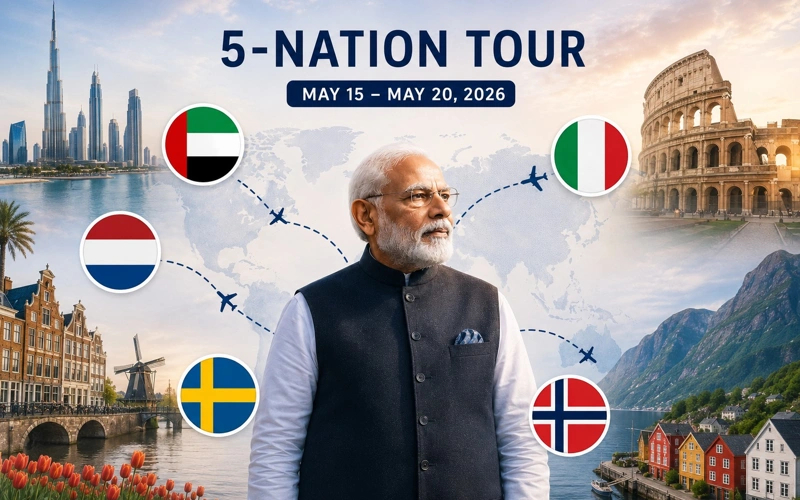
Indian Prime Minister Narendra Modi is concluding a five-nation tour that has taken him from the Gulf to Europe at a moment when India’s foreign policy is increasingly being shaped by one central question: how can the world’s fastest-growing major economy protect itself from global shocks?
From 15 to 20 May, Modi visited the United Arab Emirates, the Netherlands, Sweden, Norway and Italy. On paper, the tour focused on energy, trade, investment, technology, innovation, defence cooperation and the green transition. In reality, it was much more than a routine diplomatic journey. It was India’s attempt to secure partners, capital, technology and energy supplies in a world where instability in one region can quickly become an economic problem for New Delhi.
Reuters reported that the trip came as the Middle East crisis pushed up global oil prices and strained India’s foreign currency reserves. The agency also noted that Modi had recently urged Indians to conserve fuel, reduce imports and gold purchases, and cut travel as rising energy prices hit the country’s external buffers.
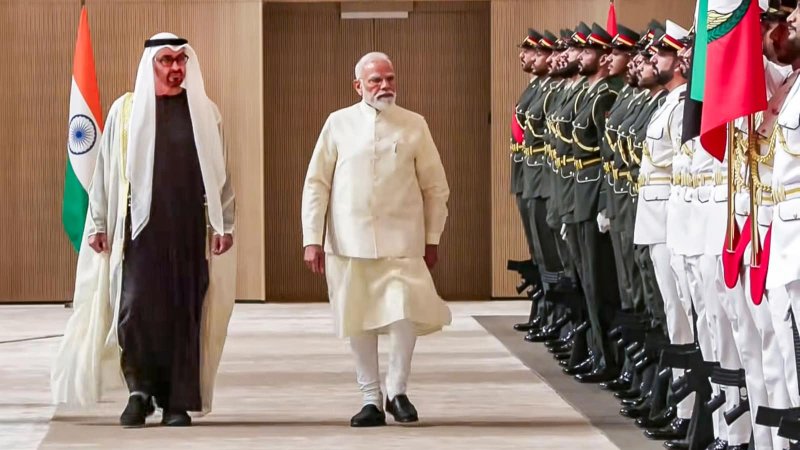
That is why the UAE was the natural first stop. Abu Dhabi is one of India’s most important Gulf partners, a major trade and investment player, and a key source of energy. India’s Ministry of External Affairs said Modi and UAE President Sheikh Mohamed bin Zayed Al Nahyan were expected to discuss bilateral issues, “in particular energy cooperation”, as well as regional and international matters. The UAE is India’s third-largest trading partner and its seventh-largest source of cumulative investment over the past 25 years. It is also home to more than 4.5 million Indians, making the relationship not only economic and strategic, but deeply human as well.
The UAE leg produced concrete results. Reuters reported that India and the UAE agreed on a framework for a strategic defence partnership and signed pacts on strategic petroleum reserves and liquefied petroleum gas supplies. The two countries also discussed expanding crude storage in India, with ADNOC potentially increasing crude oil storage capacity in India to up to 30 million barrels. This is important because strategic reserves are no longer a purely technical matter. In a period of energy disruptions, they are part of national security.
But Modi’s tour was not only about buying oil and gas. It was also about preparing India for a different energy future. After the UAE, the European leg of the trip showed how India is trying to connect its current energy needs with its long-term technological and industrial ambitions. The Netherlands, Sweden, Norway and Italy are not simply diplomatic stops. Each fits into a broader Indian strategy involving green hydrogen, semiconductors, clean technology, maritime industries, artificial intelligence, defence production, resilient supply chains and investment.
In the Netherlands, the agenda included defence, security, innovation, green hydrogen, semiconductors and water cooperation. The Dutch leg was especially important because the Netherlands is one of India’s largest trade destinations in Europe, with bilateral trade worth $27.8 billion in 2024-25. It is also India’s fourth-largest investor, with cumulative FDI of $55.6 billion. Modi’s visit came early in the tenure of the new Dutch government, giving both sides an opportunity to expand a partnership that already spans trade, technology and strategic infrastructure.
Modi also used the Netherlands stop to speak directly to the Indian diaspora and present India as a country of scale, ambition and speed. Addressing the Indian community in The Hague, he said India was no longer thinking in small terms. “Today, our India too is dreaming on a very grand scale,” he said, adding that India wanted to become a global manufacturing hub, a leader in green energy and an engine of growth for the world.
This message was designed for more than the diaspora. It was also aimed at European investors. India wants European companies to see it not simply as a market, but as a production base and technology partner. That is why the Dutch discussions on semiconductors, green hydrogen and water management matter. These are areas where India wants to move from dependence to capability.
The visit also included a major semiconductor-related development: Modi witnessed the signing of an agreement between ASML and Tata Electronics on semiconductor manufacturing, according to India’s official visit page.
The Sweden leg continued the same logic. In Gothenburg, Modi met Swedish Prime Minister Ulf Kristersson and addressed the European Round Table for Industry together with European Commission President Ursula von der Leyen. India’s Ministry of External Affairs said the two sides reviewed cooperation in the green transition, artificial intelligence, emerging technologies, start-ups, resilient supply chains, defence, space, climate action and people-to-people ties.
In Sweden, Modi’s language was especially revealing. He said India and Sweden had decided to elevate their ties to the level of a Strategic Partnership and would move forward in green transition, defence, emerging technologies and people-to-people links. He also pointed to AI, health tech and green mobility as areas with major potential. “By bringing together Sweden’s technology and India’s scale, we can create climate solutions,” he said during his press statement.
The presence of European Commission President Ursula von der Leyen gave the Sweden stop a broader India-EU dimension. Modi referred to the India-EU free trade agreement and called it, quoting von der Leyen, the “mother of all deals”. He also highlighted cooperation in digital technology, clean energy, semiconductors, resilient supply chains and innovation. This is one of the most important aspects of the tour: India is trying to build a deeper economic and strategic relationship with Europe at a time when global supply chains are being reshaped by war, sanctions, competition with China and energy insecurity.
Norway added another layer to the trip. It was Modi’s first visit to Norway and the first visit by an Indian prime minister to the country in 43 years. In Oslo, he held talks with Prime Minister Jonas Gahr Støre and participated in the 3rd India-Nordic Summit with the leaders of Norway, Denmark, Finland, Iceland and Sweden. The summit focused on technology, innovation, green transition, renewable energy, sustainability, the blue economy, defence, space and the Arctic.
At the Norway-India Business and Research Summit, Modi made one of the most important statements of the tour. He said that “food, fuel and fertiliser security” had become global challenges and argued that India and Norway were already working together to address them. He cited Orkla’s investments in India’s food sector, Equinor’s supply of LPG and LNG to India, and Yara International’s role in India’s fertiliser sector as examples of a relationship that is not theoretical, but practical. “It is a proven partnership,” he said.
Modi also invited Norway to become a major partner in India’s clean energy future. He said India had set targets of 500 gigawatts of clean energy and 5 million tonnes of green hydrogen by 2030. For Norway, a country with capital, maritime expertise, clean energy experience and a massive sovereign wealth fund, this is an attractive proposition. For India, Norwegian investment and technology can support its energy transition while also helping reduce long-term dependence on fossil fuel imports.
The India-Norway relationship was elevated to a Green Strategic Partnership during the visit. Modi said this partnership would combine India’s scale, speed and talent with Norway’s technology and capital across clean energy, climate resilience, the blue economy and green shipping. He also stressed cooperation from the Arctic to outer space, from maritime security to food security, and from digital public infrastructure to development projects in the Global South.
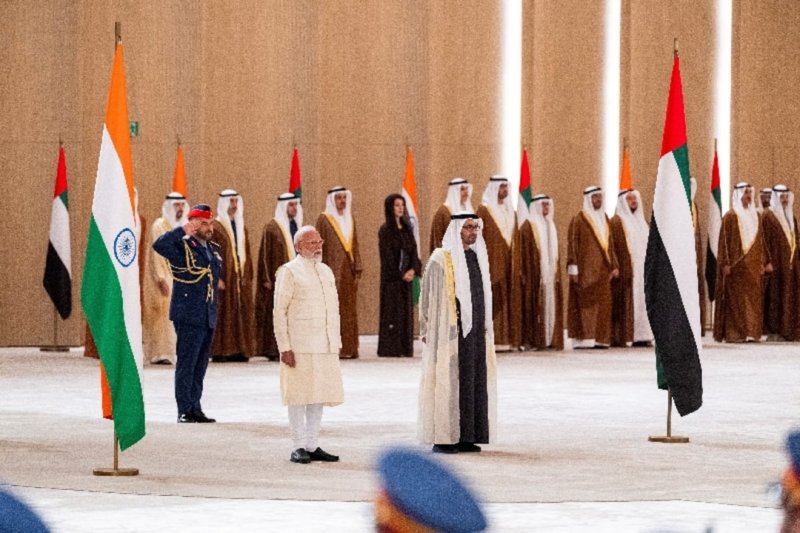
The final leg of the tour, Italy, brings Modi into another important European partnership. According to India’s Ministry of External Affairs, Modi’s official visit to Italy from 19 to 20 May includes meetings with President Sergio Mattarella and Prime Minister Giorgia Meloni. India and Italy are implementing a Joint Strategic Action Plan for 2025-2029 covering trade, investment, defence and security, clean energy, innovation, science and technology. Bilateral trade reached $16.77 billion in 2025.
Taken together, the five-nation tour reveals a clear Indian strategy. The UAE provides energy security, Gulf investment and strategic depth. The Netherlands offers trade, semiconductors, green hydrogen and water expertise. Sweden brings advanced technology, AI, defence industry cooperation and support for the green transition. Norway offers clean energy, maritime industries, LNG, fertilisers, research and sovereign investment. Italy adds defence, innovation, European political weight and industrial partnership.
For Modi, the message is that India cannot afford to be passive in a world shaped by wars, energy shocks and economic fragmentation. It must secure fuel for today, technology for tomorrow and investment for the next phase of growth.
The tour also shows that India is trying to turn vulnerability into leverage. Its huge market, young workforce, expanding middle class and infrastructure drive make it attractive to partners looking for alternatives in an uncertain global economy.
The challenge is that India’s ambitions are enormous. It wants cheap and reliable energy while moving towards a green transition. It wants to attract Western investment while preserving autonomy in foreign policy. It wants to deepen ties with Europe while maintaining strong relations with the Gulf, Russia and the Global South. It wants to become a manufacturing hub in a world where supply chains are increasingly politicised.


Similar news